扯 (chě) means "to pull; to tear; to chat" in Chinese. It has 7 strokes with the radical 扌, and is HSK Level 7.
Rated 3.5/5 in difficulty (challenging).
Harder than 17% of HSK Level 7 characters.
Appears in 3+ common words including 拉扯 (lā chě), 扯平 (chě píng), 闲扯 (xián chě).
Due to its 7 strokes, Hanzi Writer's error detection shows 扯 requires focused practice — most learners need 10+ attempts for consistent accuracy.
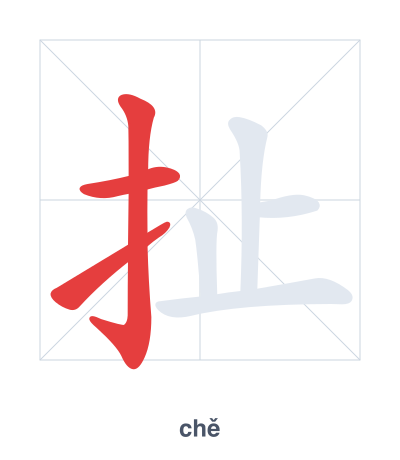
Open Hanzi Writer to see the animated stroke order and practice writing 扯 with real-time feedback.
The character 扯 (chě) is written with 7 strokes. Follow the standard Chinese stroke order: top to bottom, left to right, outside before inside. The radical 扌 is one of its key components.
Practice the correct stroke order with the Hanzi Writer app to see animated stroke-by-stroke guidance with real-time feedback.
扯 means to pull; to tear; to chat.
As an HSK Level 7 character, 扯 is an intermediate-level character.
扯 is a compound character with the hand radical 扌 (indicating a hand action) and the component 止 (originally a foot, meaning 'stop'). The hand radical suggests pulling or tearing with force, while 止 may imply controlling or halting the motion. Together, they convey the idea of using the hand to pull or tear something, and by extension, to 'chat' as in pulling words out in conversation.
💡 Memory Tip: Imagine a hand (扌) grabbing a stop sign (止) and wrenching it off the ground—that's pulling and tearing (扯)!
别拉扯我的衣服。
bié lā chě wǒ de yī fú
Don't pull at my clothes.
这样我们就扯平了。
zhè yàng wǒ men jiù chě píng le
This way, we are even.
他们在公园闲扯。
tā men zài gōng yuán xián chě
They are chatting idly in the park.
Open Hanzi Writer to see the animated stroke order and practice writing 扯 with real-time feedback.
✨ Animated stroke order · Handwriting recognition · HSK-graded practice · Free to use
扯 is made of the hand radical 扌 on the left and the component 止 (stop) on the right. The hand radical directly connects to the meanings of pulling or tearing, which are actions done with hands. The right side 止 is mainly a phonetic hint and does not contribute to the meaning.