啃 (kěn) means "to gnaw / to nibble / to bite" in Chinese. It has 11 strokes with the radical 口, and is HSK Level 7.
Rated 4.2/5 in difficulty (advanced).
Harder than 48% of HSK Level 7 characters.
Appears in 3+ common words including 啃苹果 (kěn píng guǒ), 啃书 (kěn shū), 啃骨头 (kěn gǔ tou).
Due to its 11 strokes, Hanzi Writer's error detection shows 啃 requires focused practice — most learners need 10+ attempts for consistent accuracy.
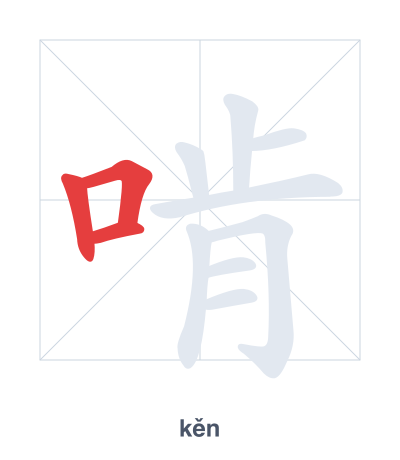
Open Hanzi Writer to see the animated stroke order and practice writing 啃 with real-time feedback.
The character 啃 (kěn) is written with 11 strokes. Follow the standard Chinese stroke order: top to bottom, left to right, outside before inside. The radical 口 is one of its key components.
Practice the correct stroke order with the Hanzi Writer app to see animated stroke-by-stroke guidance with real-time feedback.
啃 means to gnaw / to nibble / to bite.
As an HSK Level 7 character, 啃 is an intermediate-level character.
啃 combines the mouth radical 口 with the phonetic component 肯 (kěn, meaning 'to agree'). Here 口 indicates the action is done with the mouth, while 肯 provides pronunciation and hints at gnawing through a tough substance—like a determined bite through meat (月, a variant of 肉 'flesh') until you stop (止).
💡 Memory Tip: Imagine your mouth (口) stopping (止) to gnaw on a piece of meat (月) until you finally agree (肯) it's tender enough to swallow.
他在啃苹果。
tā zài kěn píng guǒ
He is gnawing on an apple.
他在努力啃书。
tā zài nǔ lì kěn shū
He is hitting the books hard.
小狗在啃骨头。
xiǎo gǒu zài kěn gǔ tou
The puppy is gnawing on a bone.
Open Hanzi Writer to see the animated stroke order and practice writing 啃 with real-time feedback.
✨ Animated stroke order · Handwriting recognition · HSK-graded practice · Free to use
啃 is composed of the mouth radical 口 (kǒu) on the left, indicating an action done with the mouth, and the phonetic component 肯 (kěn) on the right, which suggests the pronunciation. The combination means "to gnaw or bite," as the mouth is used to chew something hard.