书 (shū) means "Book" in Chinese. It has 4 strokes with the radical 丨, and is HSK Level 1.
Rated 1.9/5 in difficulty (beginner-friendly).
Harder than 12% of HSK Level 1 characters.
Appears in 3+ common words including 看书 (kàn shū), 书店 (shū diàn), 书包 (shū bāo).
In the Hanzi Writer app, most learners master 书 within 3 practice attempts using stroke-by-stroke animation.
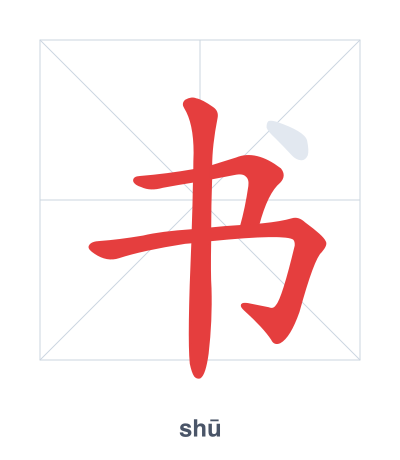
Open Hanzi Writer to see the animated stroke order and practice writing 书 with real-time feedback.
The character 书 (shū) is written with 4 strokes. Follow the standard Chinese stroke order: top to bottom, left to right, outside before inside. The radical 丨 is one of its key components.
Practice the correct stroke order with the Hanzi Writer app to see animated stroke-by-stroke guidance with real-time feedback.
书 means Book.
As an HSK Level 1 character, 书 is among the first characters beginners learn.
The traditional character 書 depicted a hand holding a brush (聿) writing, symbolizing a book or document. The simplified form 书 derives from cursive script, condensing the shape into four strokes that still evoke the idea of a bound book or written record.
💡 Memory Tip: Imagine the vertical stroke as a book spine, the two horizontal strokes as the covers, and the top dot as a bookmark tucked inside.
我喜欢在图书馆看书。
wǒ xǐ huān zài tú shū guǎn kàn shū
I like reading books in the library.
我们去书店买几本书吧。
wǒ men qù shū diàn mǎi jǐ běn shū ba
Let's go to the bookstore to buy some books.
他的书包里有很多课本。
tā de shū bāo lǐ yǒu hěn duō kè běn
There are many textbooks in his schoolbag.
Open Hanzi Writer to see the animated stroke order and practice writing 书 with real-time feedback.
✨ Animated stroke order · Handwriting recognition · HSK-graded practice · Free to use
The simplified character 书 came from the traditional 書, which showed a hand holding a brush (聿) writing on a tablet (曰). The modern shape uses a horizontal line, a vertical hook, and a dot to represent the basic idea of a book. This simplified version keeps the essential strokes while being easier to write.