苹 (píng) means "Apple; duckweed" in Chinese. It has 8 strokes with the radical 艹, and is HSK Level 3.
Rated 3.7/5 in difficulty (challenging).
Harder than 53% of HSK Level 3 characters.
Appears in 3+ common words including 苹果 (píng guǒ), 苹果汁 (píng guǒ zhī), 青苹果 (qīng píng guǒ).
Due to its 8 strokes, Hanzi Writer's error detection shows 苹 requires focused practice — most learners need 10+ attempts for consistent accuracy.
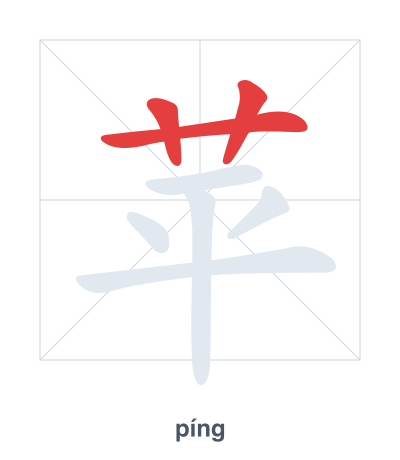
Open Hanzi Writer to see the animated stroke order and practice writing 苹 with real-time feedback.
The character 苹 (píng) is written with 8 strokes. Follow the standard Chinese stroke order: top to bottom, left to right, outside before inside. The radical 艹 is one of its key components.
Practice the correct stroke order with the Hanzi Writer app to see animated stroke-by-stroke guidance with real-time feedback.
苹 means Apple; duckweed.
As an HSK Level 3 character, 苹 is an intermediate-level character.
苹 combines the grass radical (艹) with 平 (flat), referencing duckweed's habit of floating flat on water surfaces. Its use for 'apple' is a phonetic loan, borrowing the sound from the fruit's name.
💡 Memory Tip: Imagine a flat (平) patch of grass (艹) where a shiny apple rests, as if the plant itself grew the fruit.
我每天吃一个苹果。
wǒ měi tiān chī yí gè píng guǒ
I eat an apple every day.
这杯苹果汁很好喝。
zhè bēi píng guǒ zhī hěn hǎo hē
This cup of apple juice is delicious.
这个青苹果非常酸。
zhè ge qīng píng guǒ fēi cháng suān
This green apple is extremely sour.
Open Hanzi Writer to see the animated stroke order and practice writing 苹 with real-time feedback.
✨ Animated stroke order · Handwriting recognition · HSK-graded practice · Free to use
苹 is made of two parts: the radical 艹 (grass) on top and 平 (píng, meaning flat or level) on the bottom. The grass radical shows it is a plant, while 平 hints at the flat shape of duckweed floating on water, though in modern use 苹 mostly represents the apple fruit.