根 (gēn) means "Root; Base; Measure word for long thin objects" in Chinese. It has 10 strokes with the radical 木, and is HSK Level 3.
Rated 4.2/5 in difficulty (advanced).
Harder than 81% of HSK Level 3 characters.
Appears in 3+ common words including 根本 (gēn běn), 树根 (shù gēn), 一根绳子 (yī gēn shéng zi).
Due to its 10 strokes, Hanzi Writer's error detection shows 根 requires focused practice — most learners need 10+ attempts for consistent accuracy.
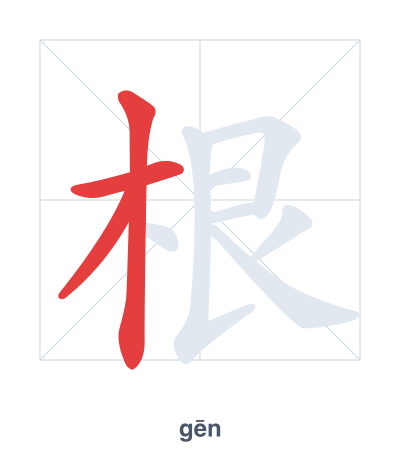
Open Hanzi Writer to see the animated stroke order and practice writing 根 with real-time feedback.
The character 根 (gēn) is written with 10 strokes. Follow the standard Chinese stroke order: top to bottom, left to right, outside before inside. The radical 木 is one of its key components.
Practice the correct stroke order with the Hanzi Writer app to see animated stroke-by-stroke guidance with real-time feedback.
根 means Root; Base; Measure word for long thin objects.
As an HSK Level 3 character, 根 is an intermediate-level character.
根 (gēn) combines the tree radical 木 with 艮 (gèn), which originally depicted a person turning around or a boundary. Here, 艮 acts as a phonetic component, but its sense of 'stopping' or 'base' also hints that the root is the part of a tree that anchors it. Together, 木 (tree) + 艮 (base) = the foundational root of a tree.
💡 Memory Tip: Picture a tree (木) whose roots form a twisted, stubborn 'L' shape (艮) as they dig deep into the ground for stability.
我根本不知道这件事。
wǒ gēn běn bù zhī dào zhè jiàn shì
I have no idea about this at all.
树根长得很深。
shù gēn zhǎng dé hěn shēn
The tree roots grow very deep.
请给我一根绳子。
qǐng gěi wǒ yī gēn shéng zi
Please give me a piece of rope.
Open Hanzi Writer to see the animated stroke order and practice writing 根 with real-time feedback.
✨ Animated stroke order · Handwriting recognition · HSK-graded practice · Free to use
根 is composed of the radical 木 (tree) on the left and 艮 (gèn) on the right. The tree component directly connects to the meaning of 'root' or 'base,' while 艮 provides the sound and suggests a firm, grounded quality. Together they indicate something attached to a tree at its base.