吉 (jí) means "Lucky or auspicious" in Chinese. It has 6 strokes with the radical 口, and is HSK Level 6.
Rated 3.2/5 in difficulty (challenging).
Harder than 9% of HSK Level 6 characters.
Appears in 3+ common words including 吉利 (jí lì), 吉祥 (jí xiáng), 吉他 (jí tā).
Due to its 6 strokes, Hanzi Writer's error detection shows 吉 requires focused practice — most learners need 10+ attempts for consistent accuracy.
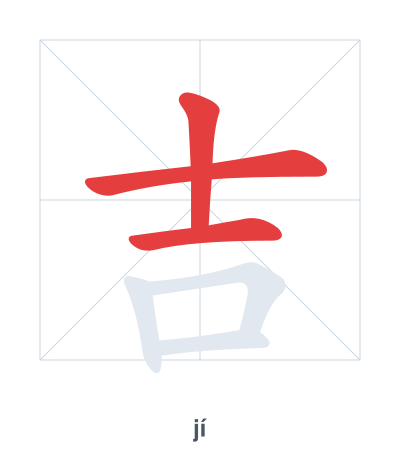
Open Hanzi Writer to see the animated stroke order and practice writing 吉 with real-time feedback.
The character 吉 (jí) is written with 6 strokes. Follow the standard Chinese stroke order: top to bottom, left to right, outside before inside. The radical 口 is one of its key components.
Practice the correct stroke order with the Hanzi Writer app to see animated stroke-by-stroke guidance with real-time feedback.
吉 means Lucky or auspicious.
As an HSK Level 6 character, 吉 is an intermediate-level character.
The character 吉 combines 士 (scholar or warrior) on top and 口 (mouth) below. In ancient China, a scholar's (士) spoken words (口) were believed to carry authority and bring good fortune, making this a compound representing luck or auspiciousness.
💡 Memory Tip: Picture a scholar (士) opening his mouth (口) to declare 'Good luck!'—the shape of the top part even looks like a lucky charm hanging from his lips.
这个数字很吉利。
zhè ge shù zì hěn jí lì
This number is very lucky.
祝你吉祥如意。
zhù nǐ jí xiáng rú yì
Wish you good fortune and success.
他会弹吉他。
tā huì dàn jí tā
He can play the guitar.
Open Hanzi Writer to see the animated stroke order and practice writing 吉 with real-time feedback.
✨ Animated stroke order · Handwriting recognition · HSK-graded practice · Free to use
吉 is composed of two parts: the top part 士 (shì, meaning scholar or person) and the bottom part 口 (kǒu, meaning mouth). Together, they suggest a person speaking words of good fortune, which relates to the meaning 'lucky' or 'auspicious'. This structural combination is a common way Chinese characters represent abstract ideas.