祥 (xiáng) means "Auspicious; lucky" in Chinese. It has 10 strokes with the radical 礻, and is HSK Level 6.
Rated 4.2/5 in difficulty (advanced).
Harder than 81% of HSK Level 6 characters.
Appears in 3+ common words including 吉祥 (jí xiáng), 慈祥 (cí xiáng), 祥和 (xiáng hé).
Due to its 10 strokes, Hanzi Writer's error detection shows 祥 requires focused practice — most learners need 10+ attempts for consistent accuracy.
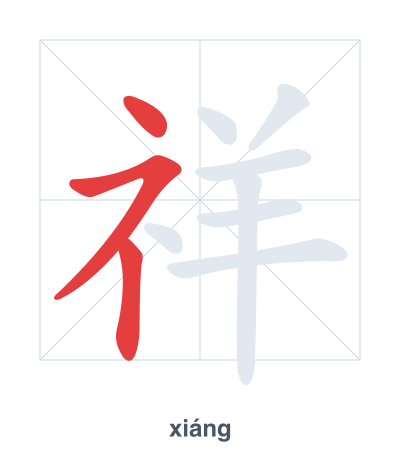
Open Hanzi Writer to see the animated stroke order and practice writing 祥 with real-time feedback.
The character 祥 (xiáng) is written with 10 strokes. Follow the standard Chinese stroke order: top to bottom, left to right, outside before inside. The radical 礻 is one of its key components.
Practice the correct stroke order with the Hanzi Writer app to see animated stroke-by-stroke guidance with real-time feedback.
祥 means Auspicious; lucky.
As an HSK Level 6 character, 祥 is an intermediate-level character.
祥 combines the radical 礻 (spirit/altar) with 羊 (sheep). In ancient China, sheep were prized sacrificial animals considered symbols of good fortune, so the character came to mean 'auspicious' or 'lucky'.
💡 Memory Tip: Picture a sheep (羊) standing beside an altar (礻) bringing blessings and good luck.
祝你吉祥如意。
zhù nǐ jí xiáng rú yì
Wish you good fortune and success.
奶奶很慈祥。
nǎi nǎi hěn cí xiáng
Grandma is very kind and gentle.
节日气氛很祥和。
jié rì qì fēn hěn xiáng hé
The festive atmosphere is very peaceful.
Open Hanzi Writer to see the animated stroke order and practice writing 祥 with real-time feedback.
✨ Animated stroke order · Handwriting recognition · HSK-graded practice · Free to use
祥 has two parts: the radical 礻 (示), meaning 'spirit' or 'altar', and 羊 (yáng), meaning 'sheep'. The sheep was a symbol of good fortune in ancient China, so together they suggest 'divine blessings' or 'auspicious signs from the gods'. This explains why 祥 means 'auspicious' or 'lucky'.