得 (de/dé/děi) means "To get / obtain / must" in Chinese. It has 11 strokes with the radical 彳, and is HSK Level 1.
Rated 3.7/5 in difficulty (challenging).
Harder than 86% of HSK Level 1 characters.
Appears in 6+ common words including 得到 (dé dào), 得意 (dé yì), 跑得快 (pǎo dé kuài).
Due to its 11 strokes, Hanzi Writer's error detection shows 得 requires focused practice — most learners need 10+ attempts for consistent accuracy.
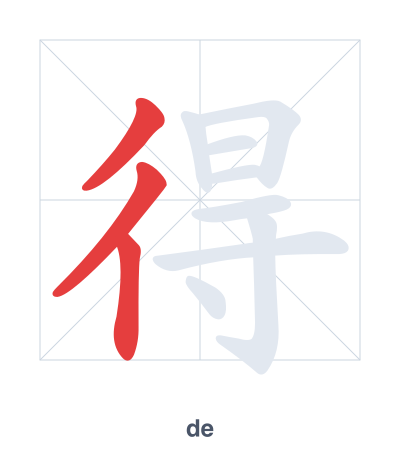
Open Hanzi Writer to see the animated stroke order and practice writing 得 with real-time feedback.
The character 得 (de/dé/děi) is written with 11 strokes. Follow the standard Chinese stroke order: top to bottom, left to right, outside before inside. The radical 彳 is one of its key components.
Practice the correct stroke order with the Hanzi Writer app to see animated stroke-by-stroke guidance with real-time feedback.
得 means To get / obtain / must.
This is a polyphonic character with readings: de, dé, děi.
As an HSK Level 1 character, 得 is among the first characters beginners learn.
得 combines the radical 彳 (indicating movement or action) with 㝵, an ancient component depicting a hand holding a valuable shell. Together, they suggest going to get something valuable, hence the meaning 'to obtain' or 'get'.
💡 Memory Tip: Imagine a traveler (彳) reaching out a hand (寸) toward the sun (日) to obtain a golden coin.
经过努力,他终于得到了冠军。
jīng guò nǔ lì tā zhōng yú dé dào le guàn jūn
Through hard work, he finally won the championship.
取得了成绩也不要太得意。
qǔ dé le chéng jì yě bú yào tài dé yì
Don't be too proud even if you have achieved success.
让他去送吧,他跑得快。
ràng tā qù sòng ba , tā pǎo dé kuài 。
Let him deliver it; he runs fast.
我觉得这个主意非常棒。
wǒ jué de zhè ge zhǔ yì fēi cháng bàng
I think this idea is great.
Open Hanzi Writer to see the animated stroke order and practice writing 得 with real-time feedback.
✨ Animated stroke order · Handwriting recognition · HSK-graded practice · Free to use
得 is made of the radical 彳 on the left, which means 'step' or 'action', and the right part 㝵, which historically shows a hand holding a shell (money). Together they suggest 'to obtain something through action', like walking to get a treasure.