记 (jì) means "To remember or record" in Chinese. It has 5 strokes with the radical 讠, and is HSK Level 1.
Rated 2.2/5 in difficulty (moderate).
Harder than 26% of HSK Level 1 characters.
Appears in 3+ common words including 记得 (jì de), 笔记 (bǐ jì), 记者 (jì zhě).
Hanzi Writer's stroke validation shows learners typically need 5-8 attempts to write 记 with correct proportion and order.
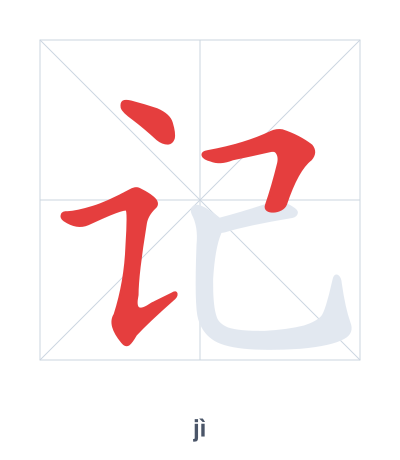
Open Hanzi Writer to see the animated stroke order and practice writing 记 with real-time feedback.
The character 记 (jì) is written with 5 strokes. Follow the standard Chinese stroke order: top to bottom, left to right, outside before inside. The radical 讠 is one of its key components.
Practice the correct stroke order with the Hanzi Writer app to see animated stroke-by-stroke guidance with real-time feedback.
记 means To remember or record.
As an HSK Level 1 character, 记 is among the first characters beginners learn.
记 combines the speech radical 讠 (言) with 己 (self), suggesting words that belong to oneself. In ancient Chinese, remembering was seen as a personal record of speech or events within one's mind. This structure visually conveys 'to record one's own words' as a way to remember.
💡 Memory Tip: Picture a person talking (讠) to themselves (己) to help remember something important.
你还记得我吗?
nǐ hái jì de wǒ ma
Do you still remember me?
请把重点记在笔记本上。
qǐng bǎ zhòng diǎn jì zài bǐ jì běn shàng
Please note down the key points in your notebook.
他是一名新闻记者。
tā shì yī míng xīn wén jì zhě
He is a journalist.
Open Hanzi Writer to see the animated stroke order and practice writing 记 with real-time feedback.
✨ Animated stroke order · Handwriting recognition · HSK-graded practice · Free to use
记 is composed of the speech radical 讠 on the left and 己 (self) on the right. The radical 讠 connects to words or speaking, while 己 suggests the self, together forming the idea of recording or remembering one's own thoughts or words.