Hanzi Writer

How to Write 憾 (hàn) — Meaning “regret”

hàn HSK Level 6 16 strokes Radical: 忄

憾 (hàn) means "regret" in Chinese. It has 16 strokes with the radical 忄, and is HSK Level 6.

Rated 4.2/5 in difficulty (advanced).

Harder than 62% of HSK Level 6 characters.

Appears in 3+ common words including 遗憾 (yí hàn), 憾事 (hàn shì), 缺憾 (quē hàn).

Due to its 16 strokes, Hanzi Writer's error detection shows 憾 requires focused practice — most learners need 10+ attempts for consistent accuracy.
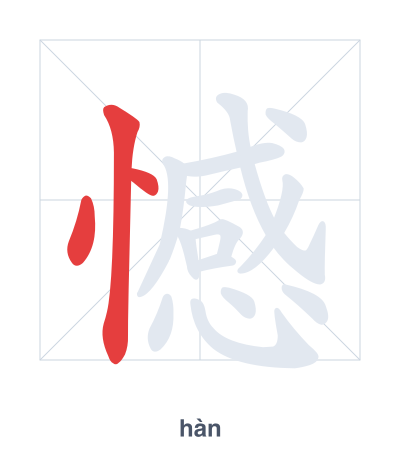
Stroke order practice for 憾 - hàn

Practice Writing 憾 (hàn)

Open Hanzi Writer to see the animated stroke order and practice writing 憾 with real-time feedback.

The character (hàn) is written with 16 strokes. Follow the standard Chinese stroke order: top to bottom, left to right, outside before inside. The radical is one of its key components.

Practice the correct stroke order with the Hanzi Writer app to see animated stroke-by-stroke guidance with real-time feedback.

means regret.

As an HSK Level 6 character, is an intermediate-level character.

Character
Pinyinhàn (han)
Meaningregret
Strokes16
Radical
HSK Level6
Difficulty4.2/5

憾 (hàn) is a phono-semantic compound. The left radical 忄 (heart) shows the word involves emotions, while the right side 感 (gǎn, meaning 'to feel') gives a clue to the sound and the idea of 'sensing' — together they express a deep, heartfelt feeling of regret or remorse.

💡 Memory Tip: Picture a heavy heart (忄) that 'senses' (感) a missed chance, pounding with regret.

yí hàn
Regret; pity
hàn shì
a matter for regret
quē hàn
regret / flaw

我感到很遗憾。

wǒ gǎn dào hěn yí hàn

I feel very regretful.

这是一件憾事。

zhè shì yī jiàn hàn shì

This is a matter of regret.

生活总有缺憾。

shēng huó zǒng yǒu quē hàn

Life always has some regrets or imperfections.

Character Pinyin Strokes Radical
(current) hàn 16
màn 14
shè 14
yōng 14
Stroke order practice for 憾 - hàn

Practice Writing 憾 (hàn)

Open Hanzi Writer to see the animated stroke order and practice writing 憾 with real-time feedback.

✨ Animated stroke order · Handwriting recognition · HSK-graded practice · Free to use

Frequently Asked Questions about 憾

The character 憾 is made of the radical 忄 (heart) on the left and the phonetic component 感 (gǎn, feeling) on the right. The heart radical indicates that the meaning relates to emotions, while 感 suggests the idea of a feeling or sensation. Together, they form the concept of a deep emotional regret or sorrow.

More HSK Level 6 Characters

Characters with Radical 忄

Other 16-Stroke Characters