慢 (màn) means "slow" in Chinese. It has 14 strokes with the radical 忄, and is HSK Level 1.
Rated 3.7/5 in difficulty (challenging).
Harder than 87% of HSK Level 1 characters.
Appears in 3+ common words including 慢慢 (màn màn), 慢走 (màn zǒu), 慢跑 (màn pǎo).
Due to its 14 strokes, Hanzi Writer's error detection shows 慢 requires focused practice — most learners need 10+ attempts for consistent accuracy.
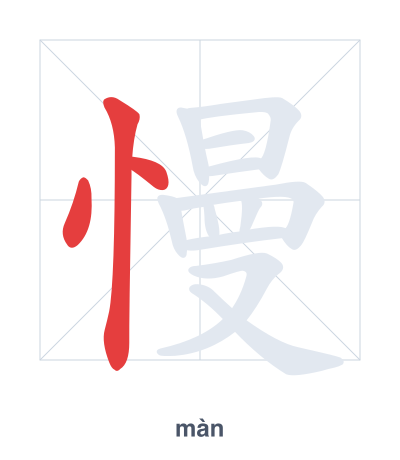
Open Hanzi Writer to see the animated stroke order and practice writing 慢 with real-time feedback.
The character 慢 (màn) is written with 14 strokes. Follow the standard Chinese stroke order: top to bottom, left to right, outside before inside. The radical 忄 is one of its key components.
Practice the correct stroke order with the Hanzi Writer app to see animated stroke-by-stroke guidance with real-time feedback.
慢 means slow.
As an HSK Level 1 character, 慢 is among the first characters beginners learn.
慢 combines the heart radical 忄 (emotion) with 曼 (prolonged, extended). The right component 曼 originally depicted a hand (又) stretching over a covering (冖) with the sun (日), conveying the idea of extension or delay. Together, the character suggests a heart or attitude that is drawn out, leading to slowness or leisurely pace.
💡 Memory Tip: Imagine your heart (忄) is dragging a long, slow snail (曼 resembles a snail with an extended shell), so you move slowly.
请慢慢吃。
qǐng màn màn chī
Please enjoy your meal.
客人请慢走。
kè rén qǐng màn zǒu
Goodbye, take care (said to a guest leaving).
我每天慢跑。
wǒ měi tiān màn pǎo
I go jogging every day.
Open Hanzi Writer to see the animated stroke order and practice writing 慢 with real-time feedback.
✨ Animated stroke order · Handwriting recognition · HSK-graded practice · Free to use
慢 consists of the radical 忄 (heart/mind) on the left, and the phonetic component 曼 on the right. The heart radical links the character to emotions or mental states, while 曼 provides the sound and contributes the idea of 'prolonged' or 'slow', together forming the word for 'slow'.