缺 (quē) means "lack / missing" in Chinese. It has 10 strokes with the radical 缶, and is HSK Level 3.
Rated 4.2/5 in difficulty (advanced).
Harder than 90% of HSK Level 3 characters.
Appears in 3+ common words including 缺点 (quē diǎn), 缺少 (quē shǎo), 缺席 (quē xí).
Due to its 10 strokes, Hanzi Writer's error detection shows 缺 requires focused practice — most learners need 10+ attempts for consistent accuracy.
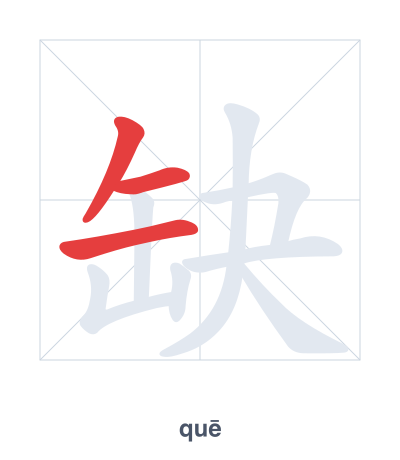
Open Hanzi Writer to see the animated stroke order and practice writing 缺 with real-time feedback.
The character 缺 (quē) is written with 10 strokes. Follow the standard Chinese stroke order: top to bottom, left to right, outside before inside. The radical 缶 is one of its key components.
Practice the correct stroke order with the Hanzi Writer app to see animated stroke-by-stroke guidance with real-time feedback.
缺 means lack / missing.
As an HSK Level 3 character, 缺 is an intermediate-level character.
The character depicts a pottery jar (缶) that has been broken or split apart—the component 夬 (guài) originally means 'split' or 'decisive,' so together they suggest a vessel with a missing piece, implying 'lack' or 'missing.'
💡 Memory Tip: Imagine a clay jar (缶) with a big chunk broken out of its side (夬 looks like a crack or a missing fragment), leaving a hole—something is definitely lacking.
每个人都有缺点。
měi gè rén dōu yǒu quē diǎn
Everyone has weaknesses.
我们缺少一些时间。
wǒ men quē shǎo yī xiē shí jiān
We are short of some time.
他今天开会缺席了。
tā jīn tiān kāi huì quē xí le
He was absent from the meeting today.
Open Hanzi Writer to see the animated stroke order and practice writing 缺 with real-time feedback.
✨ Animated stroke order · Handwriting recognition · HSK-graded practice · Free to use
The character 缺 is made of two parts: the left radical 缶, meaning a pottery jar, and the right part 夬, which suggests breaking or missing. Together they form the idea of a broken jar that is missing something, giving the meaning "lack" or "missing."