跪 (guì) means "to kneel" in Chinese. It has 13 strokes with the radical 足, and is HSK Level 6.
Rated 4.2/5 in difficulty (advanced).
Harder than 92% of HSK Level 6 characters.
Appears in 3+ common words including 跪下 (guì xià), 跪拜 (guì bài), 跪地 (guì dì).
Due to its 13 strokes, Hanzi Writer's error detection shows 跪 requires focused practice — most learners need 10+ attempts for consistent accuracy.
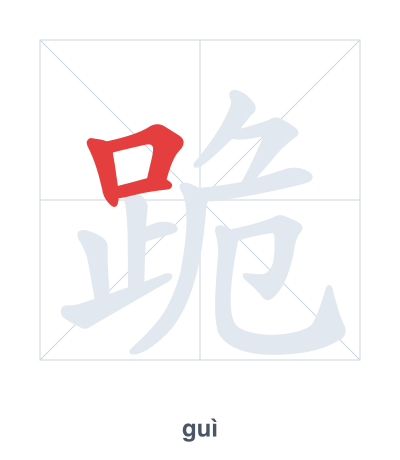
Open Hanzi Writer to see the animated stroke order and practice writing 跪 with real-time feedback.
The character 跪 (guì) is written with 13 strokes. Follow the standard Chinese stroke order: top to bottom, left to right, outside before inside. The radical 足 is one of its key components.
Practice the correct stroke order with the Hanzi Writer app to see animated stroke-by-stroke guidance with real-time feedback.
跪 means to kneel.
As an HSK Level 6 character, 跪 is an intermediate-level character.
This compound character combines the radical 足 (foot/leg) on the left with 危 (danger) on the right, which also provides the pronunciation. Kneeling involves bending the legs, and the right component suggests the vulnerable or precarious posture of kneeling.
💡 Memory Tip: Imagine a foot (足) bending dangerously (危) as a person drops to their knees in a risky plea.
他跪下向她求婚。
tā guì xià xiàng tā qiú hūn
He knelt down to propose to her.
很多人在庙里跪拜。
hěn duō rén zài miào lǐ guì bài
Many people are kneeling and praying in the temple.
他跪地寻找钥匙。
tā guì dì xún zhǎo yào shi
He knelt on the ground to look for the keys.
Open Hanzi Writer to see the animated stroke order and practice writing 跪 with real-time feedback.
✨ Animated stroke order · Handwriting recognition · HSK-graded practice · Free to use
The left side is 足 (zú), meaning foot, which shows this action uses the legs. The right side is 危 (wēi, danger), hinting that kneeling often happens in serious or dangerous situations. Together, they describe the action of bringing one's knees to the ground.