骺 (hóu) means "epiphysis" in Chinese. It has 15 strokes with the radical 骨.
Rated 4.2/5 in difficulty (advanced).
Appears in 3+ common words including 骨骺 (gǔ hóu), 骺线 (hóu xiàn), 骺软骨 (hóu ruǎn gǔ).
Due to its 15 strokes, Hanzi Writer's error detection shows 骺 requires focused practice — most learners need 10+ attempts for consistent accuracy.
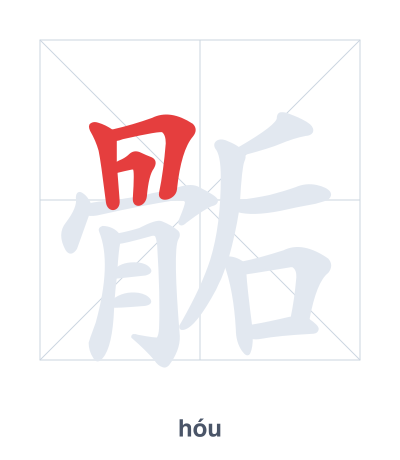
Open Hanzi Writer to see the animated stroke order and practice writing 骺 with real-time feedback.
The character 骺 (hóu) is written with 15 strokes. Follow the standard Chinese stroke order: top to bottom, left to right, outside before inside. The radical 骨 is one of its key components.
Practice the correct stroke order with the Hanzi Writer app to see animated stroke-by-stroke guidance with real-time feedback.
骺 means epiphysis.
| Character | 骺 |
| Pinyin | hóu (hou) |
| Meaning | epiphysis |
| Strokes | 15 |
| Radical | 骨 |
| Difficulty | 4.2/5 |
This compound character combines the radical 骨 (bone) with 后 (after/behind), together indicating the end part of a long bone that comes 'after' the main shaft—the epiphysis.
💡 Memory Tip: Picture a bone (骨) with a little 'back' (后) section at each end, like bony heels that cap the shaft.
骨骺线还没闭合。
gǔ hóu xiàn hái méi bì hé
The epiphyseal plate has not closed yet.
医生检查了骺线。
yī shēng jiǎn chá le hóu xiàn
The doctor examined the epiphyseal line.
骺软骨影响身高。
hóu ruǎn gǔ yǐng xiǎng shēn gāo
Epiphyseal cartilage affects height.
Open Hanzi Writer to see the animated stroke order and practice writing 骺 with real-time feedback.
✨ Animated stroke order · Handwriting recognition · HSK-graded practice · Free to use
骺 is composed of the radical 骨 (bone) on the left and 后 (hòu, behind/after) on the right. The bone radical shows that the character relates to bones, while 后 hints at the pronunciation (hóu) and suggests the "back" or "end" part of a bone, which is exactly what the epiphysis is.