骱 (jiè) means "joint" in Chinese. It has 13 strokes with the radical 骨.
Rated 4.2/5 in difficulty (advanced).
Appears in 3+ common words including 骱子 (jiè zi), 脱骱 (tuō jiè), 出骱 (chū jiè).
Due to its 13 strokes, Hanzi Writer's error detection shows 骱 requires focused practice — most learners need 10+ attempts for consistent accuracy.
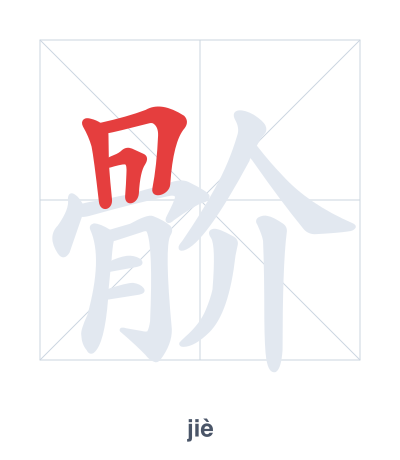
Open Hanzi Writer to see the animated stroke order and practice writing 骱 with real-time feedback.
The character 骱 (jiè) is written with 13 strokes. Follow the standard Chinese stroke order: top to bottom, left to right, outside before inside. The radical 骨 is one of its key components.
Practice the correct stroke order with the Hanzi Writer app to see animated stroke-by-stroke guidance with real-time feedback.
骱 means joint.
| Character | 骱 |
| Pinyin | jiè (jie) |
| Meaning | joint |
| Strokes | 13 |
| Radical | 骨 |
| Difficulty | 4.2/5 |
骱 (jiè) combines the radical 骨 (bone) with 介 (jiè, meaning 'to lie between' or 'scale of armor'). The component 介 suggests something that sits between or connects bones, which is exactly what a joint does. Together, the character visually depicts the meeting point where bones articulate.
💡 Memory Tip: Picture a bone (骨) with a little bridge (介) connecting two parts — that bridge is your joint.
他的骱子脱了。
tā de jiè zi tuō le
His joint is dislocated.
他的胳膊脱骱了。
tā de gē bó tuō jiè le
His arm is dislocated.
关节出骱很疼。
guān jié chū jiè hěn téng
A dislocated joint is very painful.
Open Hanzi Writer to see the animated stroke order and practice writing 骱 with real-time feedback.
✨ Animated stroke order · Handwriting recognition · HSK-graded practice · Free to use
骱 is made of two parts: the left radical 骨 (bone) and the right component 介 (jiè). The 骨 radical tells you the character is related to bones, while 介 gives the pronunciation and suggests a connection — a joint is where bones meet. Together they create the meaning of a bone joint.