骼 (gé) means "skeleton / bone" in Chinese. It has 15 strokes with the radical 骨.
Rated 4.2/5 in difficulty (advanced).
Appears in 3+ common words including 骨骼 (gǔ gé), 骨骼肌 (gǔ gé jī), 骼骨 (gé gǔ).
Due to its 15 strokes, Hanzi Writer's error detection shows 骼 requires focused practice — most learners need 10+ attempts for consistent accuracy.
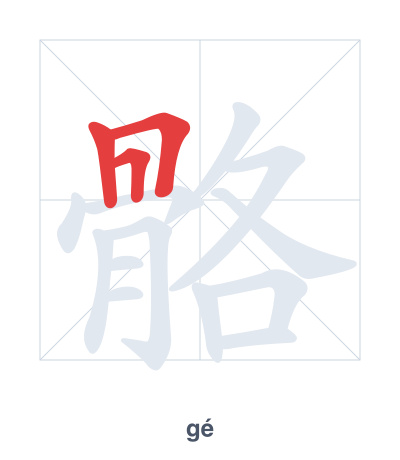
Open Hanzi Writer to see the animated stroke order and practice writing 骼 with real-time feedback.
The character 骼 (gé) is written with 15 strokes. Follow the standard Chinese stroke order: top to bottom, left to right, outside before inside. The radical 骨 is one of its key components.
Practice the correct stroke order with the Hanzi Writer app to see animated stroke-by-stroke guidance with real-time feedback.
骼 means skeleton / bone.
| Character | 骼 |
| Pinyin | gé (ge) |
| Meaning | skeleton / bone |
| Strokes | 15 |
| Radical | 骨 |
| Difficulty | 4.2/5 |
骼 is a phono-semantic compound. The left component 骨 (bone) indicates the meaning relates to the skeletal structure, while the right component 各 (gè) provides phonetic pronunciation. Together they form a character specifically referring to the bones of the skeleton.
💡 Memory Tip: Picture a complete skeleton where each (各) bone (骨) is laid out separately — that's the 骼.
人的骨骼很坚硬。
rén de gǔ gé hěn jiān yìng
Human bones are very hard.
运动需要骨骼肌配合。
yùn dòng xū yào gǔ gé jī pèi hé
Movement requires the coordination of skeletal muscles.
医生在观察他的骼骨。
yī shēng zài guān chá tā de gé gǔ
The doctor is observing his ilium.
Open Hanzi Writer to see the animated stroke order and practice writing 骼 with real-time feedback.
✨ Animated stroke order · Handwriting recognition · HSK-graded practice · Free to use
The character 骼 is composed of the radical 骨 (bone) on the left and the phonetic component 各 on the right. The radical 骨 directly indicates that the character relates to bones or the skeleton. The right part 各 gives the pronunciation 'gé' and adds no additional meaning.