髂 (qià) means "ilium" in Chinese. It has 18 strokes with the radical 骨.
Rated 4.2/5 in difficulty (advanced).
Appears in 3+ common words including 髂骨 (qià gǔ), 髂嵴 (qià jǐ), 髂窝 (qià wō).
Due to its 18 strokes, Hanzi Writer's error detection shows 髂 requires focused practice — most learners need 10+ attempts for consistent accuracy.
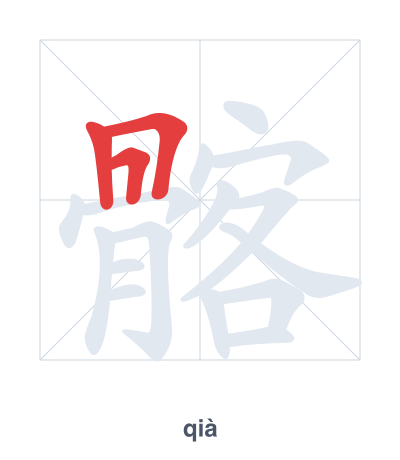
Open Hanzi Writer to see the animated stroke order and practice writing 髂 with real-time feedback.
The character 髂 (qià) is written with 18 strokes. Follow the standard Chinese stroke order: top to bottom, left to right, outside before inside. The radical 骨 is one of its key components.
Practice the correct stroke order with the Hanzi Writer app to see animated stroke-by-stroke guidance with real-time feedback.
髂 means ilium.
| Character | 髂 |
| Pinyin | qià (qia) |
| Meaning | ilium |
| Strokes | 18 |
| Radical | 骨 |
| Difficulty | 4.2/5 |
髂 is a phono-semantic compound where 骨 (bone, radical) indicates it's a type of bone, and 客 (guest) serves as a phonetic hint (originally pronounced similarly in earlier stages). The ilium is the broad, flat bone of the pelvis that acts like a 'guest host' for the hip joint.
💡 Memory Tip: Picture a bony skeleton (骨) welcoming a visiting guest (客) who sits firmly on its hip—the ilium.
髂骨位于腰部下方。
qià gǔ wèi yú yāo bù xià fāng
The ilium is located below the waist.
髂嵴是重要的解剖标志。
qià jǐ shì zhòng yào de jiě pōu biāo zhì
The iliac crest is an important anatomical landmark.
髂窝里有肌肉。
qià wō lǐ yǒu jī ròu
There are muscles in the iliac fossa.
Open Hanzi Writer to see the animated stroke order and practice writing 髂 with real-time feedback.
✨ Animated stroke order · Handwriting recognition · HSK-graded practice · Free to use
髂 is made of the radical 骨 (bone) on the left and 客 (guest) on the right. The radical shows the character is related to bones, while 客 provides the pronunciation 'qià'. Together they form a term for a specific bone in the pelvis.