骰 (tóu) means "dice" in Chinese. It has 13 strokes with the radical 骨.
Rated 4.2/5 in difficulty (advanced).
Appears in 3+ common words including 骰子 (tóu zi), 掷骰子 (zhì tóu zi), 摇骰子 (yáo tóu zi).
Due to its 13 strokes, Hanzi Writer's error detection shows 骰 requires focused practice — most learners need 10+ attempts for consistent accuracy.
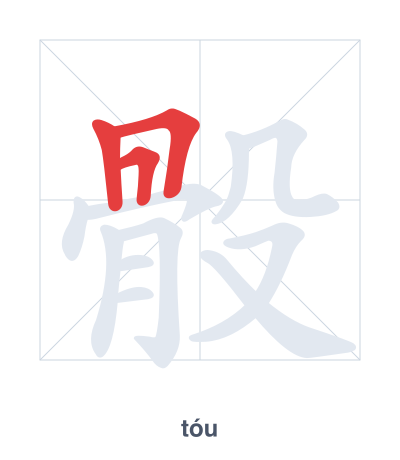
Open Hanzi Writer to see the animated stroke order and practice writing 骰 with real-time feedback.
The character 骰 (tóu) is written with 13 strokes. Follow the standard Chinese stroke order: top to bottom, left to right, outside before inside. The radical 骨 is one of its key components.
Practice the correct stroke order with the Hanzi Writer app to see animated stroke-by-stroke guidance with real-time feedback.
骰 means dice.
| Character | 骰 |
| Pinyin | tóu (tou) |
| Meaning | dice |
| Strokes | 13 |
| Radical | 骨 |
| Difficulty | 4.2/5 |
骰 combines 骨 (bone), as early dice were often carved from bone or ivory, and 殳 (a hand holding a weapon), which suggests the throwing action—just like in 投 (tóu, to throw). Thus the character visually represents a 'thrown bone' or dice.
💡 Memory Tip: Picture a bone (骨) being tossed by a hand (殳) like a dice, landing with a clatter.
我们来玩骰子吧。
wǒ men lái wán tóu zi ba
Let's play dice.
轮到你掷骰子了。
lún dào nǐ zhì tóu zi le
It's your turn to roll the dice.
他在杯子里摇骰子。
tā zài bēi zi lǐ yáo tóu zi
He is shaking dice in a cup.
Open Hanzi Writer to see the animated stroke order and practice writing 骰 with real-time feedback.
✨ Animated stroke order · Handwriting recognition · HSK-graded practice · Free to use
骰 is made of two parts: the left side 骨 (bone) and the right side 殳 (a hand holding a weapon). This structure suggests dice made from bone and the action of throwing them, since 殳 represents the hand motion used to roll or shake dice.