骸 (hái) means "skeleton / remains" in Chinese. It has 15 strokes with the radical 骨.
Rated 4.2/5 in difficulty (advanced).
Appears in 3+ common words including 骸骨 (hái gǔ), 残骸 (cán hái), 尸骸 (shī hái).
Due to its 15 strokes, Hanzi Writer's error detection shows 骸 requires focused practice — most learners need 10+ attempts for consistent accuracy.
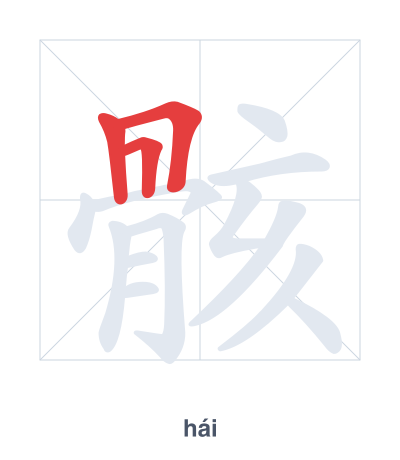
Open Hanzi Writer to see the animated stroke order and practice writing 骸 with real-time feedback.
The character 骸 (hái) is written with 15 strokes. Follow the standard Chinese stroke order: top to bottom, left to right, outside before inside. The radical 骨 is one of its key components.
Practice the correct stroke order with the Hanzi Writer app to see animated stroke-by-stroke guidance with real-time feedback.
骸 means skeleton / remains.
| Character | 骸 |
| Pinyin | hái (hai) |
| Meaning | skeleton / remains |
| Strokes | 15 |
| Radical | 骨 |
| Difficulty | 4.2/5 |
骸 combines the radical 骨 (bone) with 亥 (hài) as a phonetic component. The character literally means 'skeleton' or 'remains,' referring to the bones of a dead body.
💡 Memory Tip: Imagine a skeleton (骨) with its arms raised, waving 'Hi' (亥 sounds like 'hi') to you from its grave.
洞里发现了骸骨。
dòng lǐ fā xiàn le hái gǔ
Skeletons were found in the cave.
飞机残骸找到了。
fēi jī cán hái zhǎo dào le
The plane wreckage has been found.
掩埋地下的尸骸。
yǎn mái dì xià de shī hái
Bury the remains underground.
Open Hanzi Writer to see the animated stroke order and practice writing 骸 with real-time feedback.
✨ Animated stroke order · Handwriting recognition · HSK-graded practice · Free to use
骸 is composed of the radical 骨 (bone) on the left and the phonetic component 亥 (hài) on the right. The radical 骨 directly connects the character to bones or skeletons, while 亥 provides a hint for pronunciation. Together, the left and right parts create the meaning of skeleton or remains.