躲 (duǒ) means "to hide; to avoid" in Chinese. It has 13 strokes with the radical 身, and is HSK Level 5.
Rated 4.2/5 in difficulty (advanced).
Harder than 94% of HSK Level 5 characters.
Appears in 3+ common words including 躲雨 (duǒ yǔ), 躲开 (duǒ kāi), 躲藏 (duǒ cáng).
Due to its 13 strokes, Hanzi Writer's error detection shows 躲 requires focused practice — most learners need 10+ attempts for consistent accuracy.
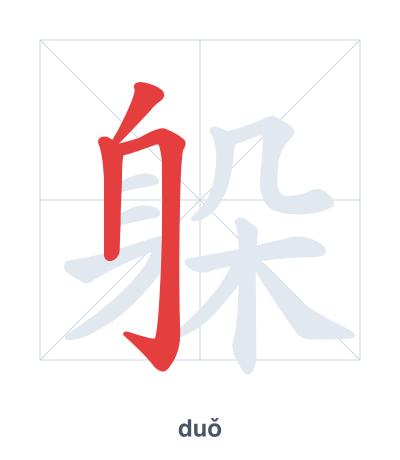
Open Hanzi Writer to see the animated stroke order and practice writing 躲 with real-time feedback.
The character 躲 (duǒ) is written with 13 strokes. Follow the standard Chinese stroke order: top to bottom, left to right, outside before inside. The radical 身 is one of its key components.
Practice the correct stroke order with the Hanzi Writer app to see animated stroke-by-stroke guidance with real-time feedback.
躲 means to hide; to avoid.
As an HSK Level 5 character, 躲 is an intermediate-level character.
The character 躲 combines the radical 身 (body) with the phonetic component 朵 (duǒ, meaning 'flower' or 'earlobe'), suggesting the body hiding behind something like a flower or an earlobe-shaped object. It visually depicts a person using their body to conceal themselves, as if ducking or dodging out of sight.
💡 Memory Tip: Imagine a body (身) crouching behind a giant, fluffy flower (朵) to hide from someone chasing them.
我们在亭子里躲雨。
wǒ men zài tíng zi lǐ duǒ yǔ
We are taking shelter from the rain in the pavilion.
快躲开那辆车!
kuài duǒ kāi nà liàng chē
Get out of the way of that car!
小猫在躲藏。
xiǎo māo zài duǒ cáng
The kitten is hiding.
Open Hanzi Writer to see the animated stroke order and practice writing 躲 with real-time feedback.
✨ Animated stroke order · Handwriting recognition · HSK-graded practice · Free to use
躲 is a phono-semantic compound. The left radical 身 (body) gives the meaning of using one's body to hide. The right part 朵 (duǒ) provides the pronunciation.