躯 (qū) means "body; torso" in Chinese. It has 11 strokes with the radical 身, and is HSK Level 7.
Rated 4.2/5 in difficulty (advanced).
Harder than 92% of HSK Level 7 characters.
Appears in 3+ common words including 躯体 (qū tǐ), 身躯 (shēn qū), 躯干 (qū gàn).
Due to its 11 strokes, Hanzi Writer's error detection shows 躯 requires focused practice — most learners need 10+ attempts for consistent accuracy.
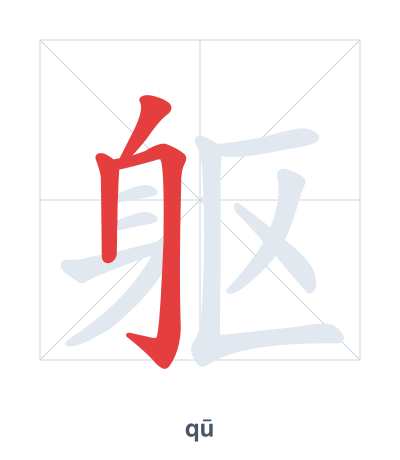
Open Hanzi Writer to see the animated stroke order and practice writing 躯 with real-time feedback.
The character 躯 (qū) is written with 11 strokes. Follow the standard Chinese stroke order: top to bottom, left to right, outside before inside. The radical 身 is one of its key components.
Practice the correct stroke order with the Hanzi Writer app to see animated stroke-by-stroke guidance with real-time feedback.
躯 means body; torso.
As an HSK Level 7 character, 躯 is an intermediate-level character.
躯 is a compound character combining the radical 身 (body) with 區 (qū, area/region). The 身 indicates the meaning relates to the body, while 區 provides pronunciation and the idea of a defined region—together they portray the torso as the central region of the body.
💡 Memory Tip: Picture the body (身) as a house, and the torso is the main area (區) where all the vital rooms are packed into three tight compartments.
保持躯体健康。
bǎo chí qū tǐ jiàn kāng
Maintain physical health.
他有强壮的身躯。
tā yǒu qiáng zhuàng de shēn qū
He has a strong body.
树木的躯干很粗。
shù mù de qū gàn hěn cū
The tree trunk is very thick.
Open Hanzi Writer to see the animated stroke order and practice writing 躯 with real-time feedback.
✨ Animated stroke order · Handwriting recognition · HSK-graded practice · Free to use
The left side is the radical 身, which means 'body.' The right side is 区 (qū), which hints at the pronunciation. Together they form a character meaning 'body' or 'torso,' focusing on the physical form.