Hanzi Writer

How to Write 藏 (cáng/zàng) — Meaning “To hide / To store / Tibet”

cáng/zàng HSK Level 6 17 strokes Radical: 艹

藏 (cáng/zàng) means "To hide / To store / Tibet" in Chinese. It has 17 strokes with the radical 艹, and is HSK Level 6.

Rated 4.2/5 in difficulty (advanced).

Harder than 88% of HSK Level 6 characters.

Appears in 4+ common words including 收藏 (shōu cáng), 隐藏 (yǐn cáng), 宝藏 (bǎo zàng).

Due to its 17 strokes, Hanzi Writer's error detection shows 藏 requires focused practice — most learners need 10+ attempts for consistent accuracy.
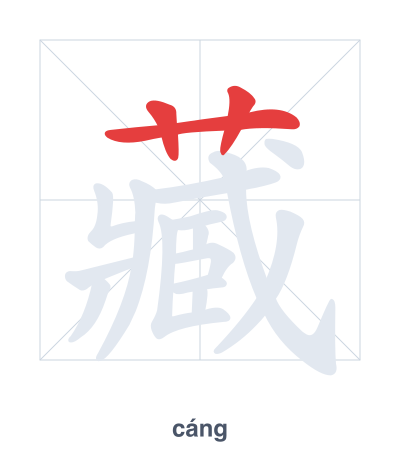
Stroke order practice for 藏 - cáng/zàng

Practice Writing 藏 (cáng/zàng)

Open Hanzi Writer to see the animated stroke order and practice writing 藏 with real-time feedback.

The character (cáng/zàng) is written with 17 strokes. Follow the standard Chinese stroke order: top to bottom, left to right, outside before inside. The radical is one of its key components.

Practice the correct stroke order with the Hanzi Writer app to see animated stroke-by-stroke guidance with real-time feedback.

means To hide / To store / Tibet.

This is a polyphonic character with readings: cáng, zàng.

As an HSK Level 6 character, is an intermediate-level character.

Character
Pinyincáng / zàng (cang/zang)
MeaningTo hide / To store / Tibet
Strokes17
Radical
HSK Level6
Difficulty4.2/5

藏 is a compound of 艹 (grass, suggesting covering) and 臧 (zāng, providing sound and the idea of concealment). Originally 臧 depicted a person with a weapon (戈) and an eye (臣), symbolizing a captured slave or hidden loot, thus reinforcing the meaning 'to hide' or 'to store' under grass. The Tibet meaning is a later phonetic borrowing for the region's name.

💡 Memory Tip: Picture grass (艹) covering a minister (臣) hiding a weapon (戈) in a secret storage spot.

shōu cáng
to collect; collection
yǐn cáng
to hide; to conceal
bǎo zàng
treasure
西 xī zàng
Tibet

他非常喜欢收藏古钱币。

tā fēi cháng xǐ huān shōu cáng gǔ qián bì

He really likes collecting ancient coins.

敌军躲在深山里,隐藏得非常隐秘。

dí jūn duǒ zài shēn shān lǐ yǐn cáng dé fēi cháng yǐn mì

The enemy troops hid in the deep mountains, very well concealed.

传说这片森林深处埋藏着巨大的宝藏。

chuán shuō zhè piàn sēn lín shēn chù mái cáng zhe jù dà de bǎo zàng

Legend has it that a huge treasure is buried deep in this forest.

西藏是一个充满神秘色彩的高原。

xī zàng shì yí gè chōng mǎn shén mì sè cǎi de gāo yuán

Tibet is a plateau full of mystery.

Character Pinyin Strokes Radical
(current) cáng / zàng 17
shū 15
fān 15
xùn 15
Stroke order practice for 藏 - cáng/zàng

Practice Writing 藏 (cáng/zàng)

Open Hanzi Writer to see the animated stroke order and practice writing 藏 with real-time feedback.

✨ Animated stroke order · Handwriting recognition · HSK-graded practice · Free to use

Frequently Asked Questions about 藏

藏 is composed of the grass radical 艹 on top and the phonetic component 臧 (zāng) below. The grass radical suggests hiding or storing among plants, connecting to meanings like 'to hide' or 'to store'. The component 臧 provides the sound and also carries a sense of concealment.

More HSK Level 6 Characters

Characters with Radical 艹

Other 17-Stroke Characters