躺 (tǎng) means "to lie down" in Chinese. It has 15 strokes with the radical 身, and is HSK Level 4.
Rated 4.2/5 in difficulty (advanced).
Harder than 93% of HSK Level 4 characters.
Appears in 3+ common words including 躺下 (tǎng xià), 躺椅 (tǎng yǐ), 躺着 (tǎng zhe).
Due to its 15 strokes, Hanzi Writer's error detection shows 躺 requires focused practice — most learners need 10+ attempts for consistent accuracy.
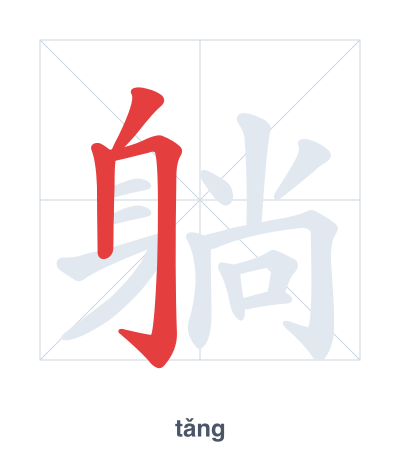
Open Hanzi Writer to see the animated stroke order and practice writing 躺 with real-time feedback.
The character 躺 (tǎng) is written with 15 strokes. Follow the standard Chinese stroke order: top to bottom, left to right, outside before inside. The radical 身 is one of its key components.
Practice the correct stroke order with the Hanzi Writer app to see animated stroke-by-stroke guidance with real-time feedback.
躺 means to lie down.
As an HSK Level 4 character, 躺 is an intermediate-level character.
躺 is a phono-semantic compound. The left radical 身 (body) depicts a reclining figure, while the right component 尚 (shàng) provides the pronunciation and subtly hints at a state of stillness or leisure. Together, they form the image of a body lying down.
💡 Memory Tip: Picture a tired person (身) flopping onto a sofa and sighing 'Shang!' (尚) as they finally lie down.
他累得躺下了。
tā lèi dé tǎng xià le
He was so tired that he lay down.
爷爷坐在躺椅上。
yé yé zuò zài tǎng yǐ shàng
Grandpa is sitting on a lounge chair.
他躺着看书。
tā tǎng zhe kàn shū
He is reading while lying down.
Open Hanzi Writer to see the animated stroke order and practice writing 躺 with real-time feedback.
✨ Animated stroke order · Handwriting recognition · HSK-graded practice · Free to use
躺 is made of the radical 身 (body) on the left and 尚 (shàng, still/upwards) on the right. The radical 身 suggests the body, and 尚 adds a sense of 'placing' or 'settling,' together meaning to lay the body down. This structure directly conveys the idea of lying down.