躬 (gōng) means "to bow; personally" in Chinese. It has 10 strokes with the radical 身, and is HSK Level 7.
Rated 4.2/5 in difficulty (advanced).
Harder than 92% of HSK Level 7 characters.
Appears in 3+ common words including 鞠躬 (jū gōng), 躬身 (gōng shēn), 亲躬 (qīn gōng).
Due to its 10 strokes, Hanzi Writer's error detection shows 躬 requires focused practice — most learners need 10+ attempts for consistent accuracy.
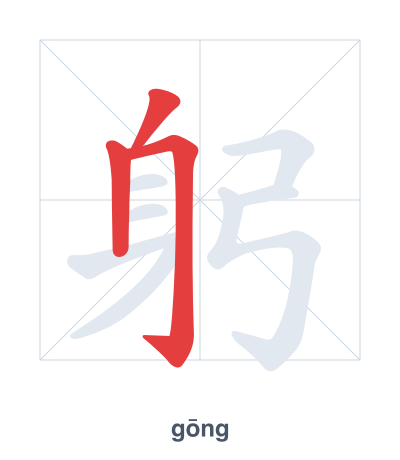
Open Hanzi Writer to see the animated stroke order and practice writing 躬 with real-time feedback.
The character 躬 (gōng) is written with 10 strokes. Follow the standard Chinese stroke order: top to bottom, left to right, outside before inside. The radical 身 is one of its key components.
Practice the correct stroke order with the Hanzi Writer app to see animated stroke-by-stroke guidance with real-time feedback.
躬 means to bow; personally.
As an HSK Level 7 character, 躬 is an intermediate-level character.
躬 combines the radical 身 (body) and the phonetic component 弓 (bow, gōng). The visual form suggests a body (身) bending like a bow (弓), directly illustrating the action of bowing. This structure also extends to the meaning 'personally,' as it involves one's own body.
💡 Memory Tip: Picture your body (身) curved into the shape of a bow (弓) as you bend forward to bow deeply.
他向大家鞠躬。
tā xiàng dà jiā jū gōng
He bowed to everyone.
他躬身行礼。
tā gōng shēn xíng lǐ
He bowed.
这件事他必亲躬。
zhè jiàn shì tā bì qīn gōng
He must handle this matter personally.
Open Hanzi Writer to see the animated stroke order and practice writing 躬 with real-time feedback.
✨ Animated stroke order · Handwriting recognition · HSK-graded practice · Free to use
躬 is made of 身 (body) on the left and 弓 (bow) on the right. The image of a body bending like a bow suggests the actions of bowing or bending over. This also connects to the meaning "personally" as in doing something with one's own body.