独 (dú) means "alone / single" in Chinese. It has 9 strokes with the radical 犭, and is HSK Level 4.
Rated 4/5 in difficulty (challenging).
Harder than 62% of HSK Level 4 characters.
Appears in 3+ common words including 独立 (dú lì), 孤独 (gū dú), 独自 (dú zì).
Due to its 9 strokes, Hanzi Writer's error detection shows 独 requires focused practice — most learners need 10+ attempts for consistent accuracy.
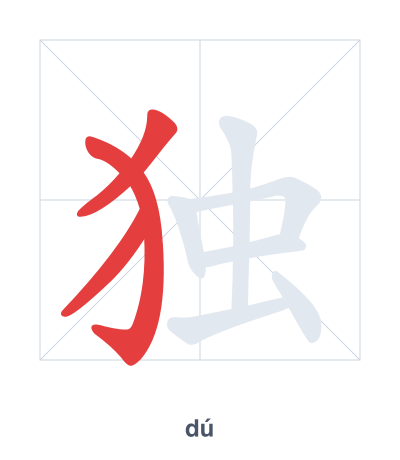
Open Hanzi Writer to see the animated stroke order and practice writing 独 with real-time feedback.
The character 独 (dú) is written with 9 strokes. Follow the standard Chinese stroke order: top to bottom, left to right, outside before inside. The radical 犭 is one of its key components.
Practice the correct stroke order with the Hanzi Writer app to see animated stroke-by-stroke guidance with real-time feedback.
独 means alone / single.
As an HSK Level 4 character, 独 is an intermediate-level character.
The character 独 combines the dog radical (犭) with the insect component (虫), originally depicting a dog hunting alone—emphasizing the idea of solitary action.
💡 Memory Tip: Picture a lone dog (犭) chasing a single insect (虫) across an empty field, completely by itself.
孩子要学会独立生活。
hái zi yào xué huì dú lì shēng huó
Children need to learn to live independently.
一个人住会觉得孤独吗?
yí gè rén zhù huì jué de gū dú ma
Do you feel lonely living alone?
他独自去北京旅游了。
tā dú zì qù běi jīng lǚ yóu le
He went on a trip to Beijing by himself.
Open Hanzi Writer to see the animated stroke order and practice writing 独 with real-time feedback.
✨ Animated stroke order · Handwriting recognition · HSK-graded practice · Free to use
The character 独 is made of the left radical 犭, which represents an animal or dog, and the right part 虫, meaning insect. Although the insect component does not directly indicate 'alone', the animal radical hints at wild animals that often live solitary lives, supporting the meaning of 'alone' or 'single'.