犴 (àn) means "jail; wild dog" in Chinese. It has 6 strokes with the radical 犭.
Rated 3.2/5 in difficulty (challenging).
Appears in 3+ common words including 犴狱 (àn yù), 驼犴 (tuó àn), 犴狴 (àn bì).
Due to its 6 strokes, Hanzi Writer's error detection shows 犴 requires focused practice — most learners need 10+ attempts for consistent accuracy.
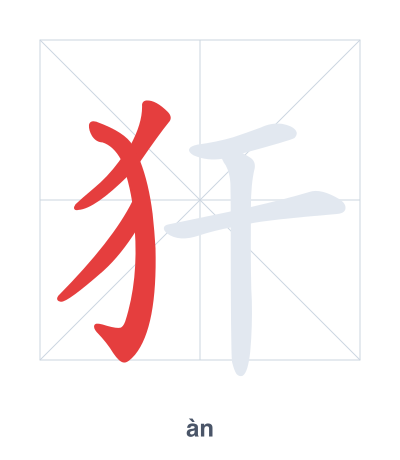
Open Hanzi Writer to see the animated stroke order and practice writing 犴 with real-time feedback.
The character 犴 (àn) is written with 6 strokes. Follow the standard Chinese stroke order: top to bottom, left to right, outside before inside. The radical 犭 is one of its key components.
Practice the correct stroke order with the Hanzi Writer app to see animated stroke-by-stroke guidance with real-time feedback.
犴 means jail; wild dog.
犴 combines the dog radical 犭 with 干 (gàn) as a phonetic component. Originally it meant a wild dog, and later it came to mean 'jail' because such fierce dogs were used as prison guards.
💡 Memory Tip: Picture a wild dog (犭) chained to a metal bar (干) inside a jail cell.
犴狱就是监狱。
àn yù jiù shì jiān yù
'Ànyù' means prison.
驼犴是一种鹿。
tuó àn shì yī zhǒng lù
The moose is a type of deer.
这是古代的词语。
zhè shì gǔ dài de cí yǔ
This is an ancient word.
Open Hanzi Writer to see the animated stroke order and practice writing 犴 with real-time feedback.
✨ Animated stroke order · Handwriting recognition · HSK-graded practice · Free to use
犴 uses the radical 犭 (dog/enemy) on the left, which often indicates animals or wild behavior. The right part is 干 (gàn), originally a pole or shield, but here it gives a sound hint. Together, the structure suggests a wild dog (one meaning) or an enclosure made of poles (leading to the jail meaning).