犷 (guǎng) means "wild; unrefined; rugged" in Chinese. It has 6 strokes with the radical 犭.
Rated 3.2/5 in difficulty (challenging).
Appears in 3+ common words including 粗犷 (cū guǎng), 犷悍 (guǎng hàn), 犷野 (guǎng yě).
Due to its 6 strokes, Hanzi Writer's error detection shows 犷 requires focused practice — most learners need 10+ attempts for consistent accuracy.
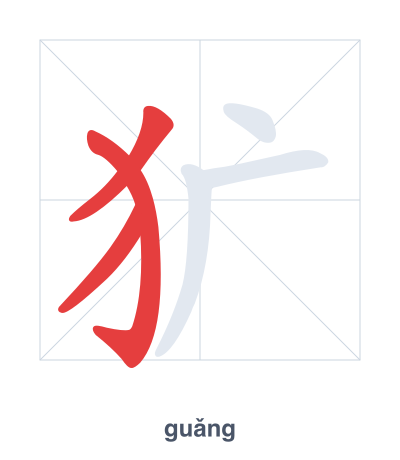
Open Hanzi Writer to see the animated stroke order and practice writing 犷 with real-time feedback.
The character 犷 (guǎng) is written with 6 strokes. Follow the standard Chinese stroke order: top to bottom, left to right, outside before inside. The radical 犭 is one of its key components.
Practice the correct stroke order with the Hanzi Writer app to see animated stroke-by-stroke guidance with real-time feedback.
犷 means wild; unrefined; rugged.
犷 is a phono-semantic compound: the radical 犭 (dog/beast) indicates a wild animal, while the component 广 (guǎng) provides the pronunciation. Together they convey the meaning of being untamed, rugged, or unrefined.
💡 Memory Tip: Picture a wild dog (犭) running loose across a wide open plain (广), rough and untamed.
他的性格很粗犷。
tā de xìng gé hěn cū guǎng
He has a bold and uninhibited personality.
那个人很犷悍。
nà ge rén hěn guǎng hàn
That person is very fierce and tough.
这里的风景很犷野。
zhè lǐ de fēng jǐng hěn guǎng yě
The scenery here is very wild and rugged.
Open Hanzi Writer to see the animated stroke order and practice writing 犷 with real-time feedback.
✨ Animated stroke order · Handwriting recognition · HSK-graded practice · Free to use
犷 has two parts: the radical 犭 (dog) on the left and 广 (wide) on the right. The dog radical hints at wild or animal-like behavior, while 广 provides the pronunciation guǎng and suggests something broad or rough. Together they convey the idea of being wild, unrefined, or rugged.