犰 (qiú) means "armadillo (first character of 'qiúyú')" in Chinese. It has 5 strokes with the radical 犭.
Rated 2.9/5 in difficulty (moderate).
Appears in 3+ common words including 犰狳 (qiú yú), 小犰狳 (xiǎo qiú yú), 犰狳皮 (qiú yú pí).
Hanzi Writer's stroke validation shows learners typically need 5-8 attempts to write 犰 with correct proportion and order.
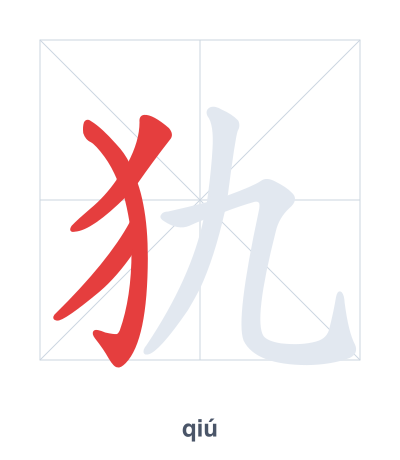
Open Hanzi Writer to see the animated stroke order and practice writing 犰 with real-time feedback.
The character 犰 (qiú) is written with 5 strokes. Follow the standard Chinese stroke order: top to bottom, left to right, outside before inside. The radical 犭 is one of its key components.
Practice the correct stroke order with the Hanzi Writer app to see animated stroke-by-stroke guidance with real-time feedback.
犰 means armadillo (first character of 'qiúyú').
犰 is a phono-semantic compound. The radical 犭 (dog/animal) indicates it refers to an animal, while the right component 九 (nine) provides the pronunciation qiú. This character was created to transliterate the name of the armadillo, an animal not native to China.
💡 Memory Tip: Picture a dog (犭) with a shell that has nine (九) distinct bands, curling into a ball like an armadillo.
我见过犰狳。
wǒ jiàn guò qiú yú
I have seen an armadillo.
小犰狳很可爱。
xiǎo qiú yú hěn kě ài
The baby armadillo is very cute.
犰狳皮很硬。
qiú yú pí hěn yìng
The armadillo's skin is very tough.
Open Hanzi Writer to see the animated stroke order and practice writing 犰 with real-time feedback.
✨ Animated stroke order · Handwriting recognition · HSK-graded practice · Free to use
犰 is a left-right character. The left component 犭 (animal radical) shows that the character relates to animals, and the right component 九 (nine) provides a hint for pronunciation, though the exact origin is unclear. Together they form the first part of the word 犰狳, which means armadillo.