犾 (yín) means "the character 'yín' (an ancient word for dog)" in Chinese. It has 7 strokes with the radical 犭.
Rated 3.5/5 in difficulty (challenging).
Appears in 3+ common words including 犾犾 (yín yín), 犾字 (yín zì), 犾部 (yín bù).
Due to its 7 strokes, Hanzi Writer's error detection shows 犾 requires focused practice — most learners need 10+ attempts for consistent accuracy.
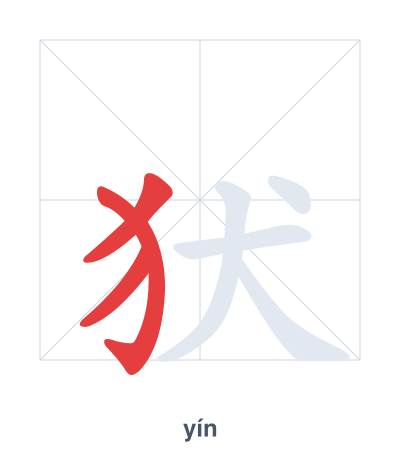
Open Hanzi Writer to see the animated stroke order and practice writing 犾 with real-time feedback.
The character 犾 (yín) is written with 7 strokes. Follow the standard Chinese stroke order: top to bottom, left to right, outside before inside. The radical 犭 is one of its key components.
Practice the correct stroke order with the Hanzi Writer app to see animated stroke-by-stroke guidance with real-time feedback.
犾 means the character 'yín' (an ancient word for dog).
犾 is a compound of two dog-related radicals: the left side 犭 (a simplified form of 犬) and the right side 犬 (dog). Both components visually represent dogs, doubling the canine imagery to emphasize the meaning 'ancient word for dog.'
💡 Memory Tip: Picture two dogs (犭 and 犬) standing side by side, barking together to remind you this old character means 'dog.'
犾犾是狗叫声。
yín yín shì gǒu jiào shēng
'Yin-yin' is the sound of a dog barking.
犾字有两个犬。
yín zì yǒu liǎng gè quǎn
The character '犾' consists of two 'dog' components.
犾字属于犬部。
yín zì shǔ yú quǎn bù
The character '犾' belongs to the dog radical.
Open Hanzi Writer to see the animated stroke order and practice writing 犾 with real-time feedback.
✨ Animated stroke order · Handwriting recognition · HSK-graded practice · Free to use
犾 is made of the radical 犭 (dog) on the left and the character 犬 (dog) on the right. Both parts mean "dog," so together they strongly reinforce the ancient meaning of "dog." This double-dog structure is rare and unique to this character.