犹 (yóu) means "still; yet; like" in Chinese. It has 7 strokes with the radical 犭, and is HSK Level 5.
Rated 3.5/5 in difficulty (challenging).
Harder than 27% of HSK Level 5 characters.
Appears in 3+ common words including 犹豫 (yóu yù), 犹如 (yóu rú), 犹太 (yóu tài).
Due to its 7 strokes, Hanzi Writer's error detection shows 犹 requires focused practice — most learners need 10+ attempts for consistent accuracy.
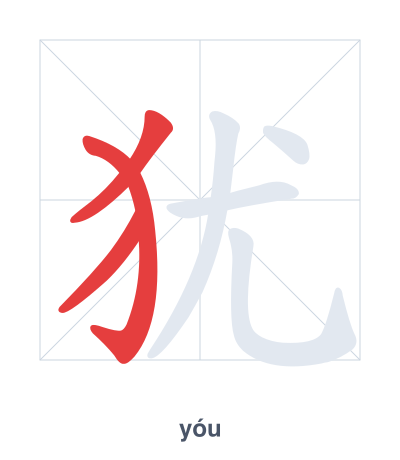
Open Hanzi Writer to see the animated stroke order and practice writing 犹 with real-time feedback.
The character 犹 (yóu) is written with 7 strokes. Follow the standard Chinese stroke order: top to bottom, left to right, outside before inside. The radical 犭 is one of its key components.
Practice the correct stroke order with the Hanzi Writer app to see animated stroke-by-stroke guidance with real-time feedback.
犹 means still; yet; like.
As an HSK Level 5 character, 犹 is an intermediate-level character.
Originally a pictograph of a type of monkey, 犹 now uses the dog radical (犭) to hint at an animal, while the phonetic component 尤 provides the sound yóu. The character later acquired the abstract meanings 'still' and 'like' through phonetic loan, with no direct visual link to its current meanings.
💡 Memory Tip: Picture a dog (犭) standing especially (尤) still—it hasn't moved yet, like a statue.
别再犹豫了。
bié zài yóu yù le
Don't hesitate anymore.
这里犹如天堂。
zhè lǐ yóu rú tiān táng
This place is like paradise.
他是犹太人。
tā shì yóu tài rén
He is Jewish.
Open Hanzi Writer to see the animated stroke order and practice writing 犹 with real-time feedback.
✨ Animated stroke order · Handwriting recognition · HSK-graded practice · Free to use
犹 is composed of the radical 犭 (dog/animal) on the left and the component 尤 on the right. The radical suggests animal behavior, and the right side gives the pronunciation "yóu". While the original meaning may have been connected to a type of animal, modern meanings of "still", "yet", and "like" come from extended usage.