自 (zì) means "self; from" in Chinese. It has 6 strokes with the radical 自, and is HSK Level 2.
Rated 2/5 in difficulty (beginner-friendly).
Harder than 8% of HSK Level 2 characters.
Appears in 3+ common words including 自己 (zì jǐ), 自动 (zì dòng), 自由 (zì yóu).
In the Hanzi Writer app, most learners master 自 within 3 practice attempts using stroke-by-stroke animation.
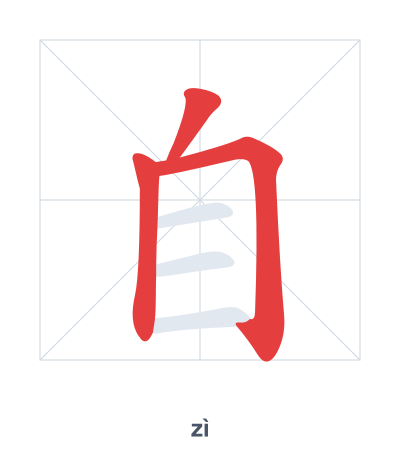
Open Hanzi Writer to see the animated stroke order and practice writing 自 with real-time feedback.
The character 自 (zì) is written with 6 strokes. Follow the standard Chinese stroke order: top to bottom, left to right, outside before inside. The radical 自 is one of its key components.
Practice the correct stroke order with the Hanzi Writer app to see animated stroke-by-stroke guidance with real-time feedback.
自 means self; from.
As an HSK Level 2 character, 自 is among the first characters beginners learn.
The character 自 originally depicted a nose, with the top stroke representing the bridge and the lower part showing nostrils. In ancient Chinese, people would point to their own nose to refer to themselves, so the nose came to mean 'self' or 'from' (as in originating from oneself).
💡 Memory Tip: Imagine a profile of a face with a prominent nose (自) and think, 'This nose belongs to me, myself.'
我自己去学校。
wǒ zì jǐ qù xué xiào
I go to school by myself.
这是一个自动门。
zhè shì yí gè zì dòng mén
This is an automatic door.
鸟儿在天空自由飞。
niǎo ér zài tiān kōng zì yóu fēi
The bird flies freely in the sky.
Open Hanzi Writer to see the animated stroke order and practice writing 自 with real-time feedback.
✨ Animated stroke order · Handwriting recognition · HSK-graded practice · Free to use
自 is a pictograph that originally depicted a nose. The shape shows the bridge and nostrils, and because people often point to their nose when referring to themselves, the meaning expanded from 'nose' to 'self'.