犸 (mà) means "mammoth (used in 'měngmǎ')" in Chinese. It has 6 strokes with the radical 犭.
Rated 3.2/5 in difficulty (challenging).
Appears in 3+ common words including 猛犸 (měng mà), 猛犸象 (měng mà xiàng), 犸象 (mà xiàng).
Due to its 6 strokes, Hanzi Writer's error detection shows 犸 requires focused practice — most learners need 10+ attempts for consistent accuracy.
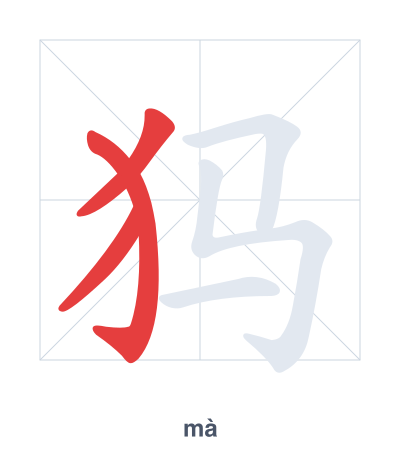
Open Hanzi Writer to see the animated stroke order and practice writing 犸 with real-time feedback.
The character 犸 (mà) is written with 6 strokes. Follow the standard Chinese stroke order: top to bottom, left to right, outside before inside. The radical 犭 is one of its key components.
Practice the correct stroke order with the Hanzi Writer app to see animated stroke-by-stroke guidance with real-time feedback.
犸 means mammoth (used in 'měngmǎ').
犸 is a phono-semantic compound where the radical 犭 (animal) indicates it's a beast, and 马 (mǎ) provides the pronunciation mà. It was created specifically to write the word 猛犸 (měngmà), meaning 'mammoth', a prehistoric creature unrelated to horses but using the horse character for its sound.
💡 Memory Tip: Picture a mammoth (犭) with the body of a horse (马) and giant tusks, but it clumsily trips over its own feet—that’s why it went extinct!
猛犸象很大。
měng mà xiàng hěn dà
Mammoths were very large.
猛犸象已经灭绝了。
měng mà xiàng yǐ jīng miè jué le
Mammoths are already extinct.
这是犸象的化石。
zhè shì mà xiàng de huà shí
This is a mammoth fossil.
Open Hanzi Writer to see the animated stroke order and practice writing 犸 with real-time feedback.
✨ Animated stroke order · Handwriting recognition · HSK-graded practice · Free to use
犸 is made of the radical 犭 (animal) on the left and 马 (horse) on the right. The radical 犭 shows it is an animal, while 马 gives the sound mǎ and hints at a large, horse-like creature. Together they form the character used in "mammoth" (猛犸).