孤 (gū) means "orphan; lonely; solitary" in Chinese. It has 8 strokes with the radical 子, and is HSK Level 6.
Rated 3.7/5 in difficulty (challenging).
Harder than 25% of HSK Level 6 characters.
Appears in 3+ common words including 孤独 (gū dú), 孤单 (gū dān), 孤儿 (gū ér).
Due to its 8 strokes, Hanzi Writer's error detection shows 孤 requires focused practice — most learners need 10+ attempts for consistent accuracy.
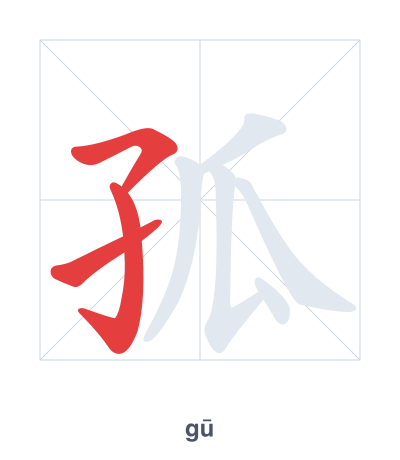
Open Hanzi Writer to see the animated stroke order and practice writing 孤 with real-time feedback.
The character 孤 (gū) is written with 8 strokes. Follow the standard Chinese stroke order: top to bottom, left to right, outside before inside. The radical 子 is one of its key components.
Practice the correct stroke order with the Hanzi Writer app to see animated stroke-by-stroke guidance with real-time feedback.
孤 means orphan; lonely; solitary.
As an HSK Level 6 character, 孤 is an intermediate-level character.
孤 is a phono-semantic compound: the radical 子 (child) indicates a young person, while 瓜 (melon) provides pronunciation (gū). The character originally pictured a child without a father, later extended to any isolated or solitary being.
💡 Memory Tip: Picture a lone child (子) sitting next to a single melon (瓜) in an empty field — no family, just a lonely orphan with his only companion.
他一个人住,很孤独。
tā yí gè rén zhù hěn gū dú
He lives alone and is very lonely.
我不喜欢孤单的感觉。
wǒ bù xǐ huān gū dān de gǎn jué
I don't like the feeling of being lonely.
他从小就是一个孤儿。
tā cóng xiǎo jiù shì yí gè gū ér
He has been an orphan since childhood.
Open Hanzi Writer to see the animated stroke order and practice writing 孤 with real-time feedback.
✨ Animated stroke order · Handwriting recognition · HSK-graded practice · Free to use
孤 is a left-right character. The left side is 子 (child), and the right side is 瓜 (melon or gourd). Together, they suggest a child left alone like a single gourd, which connects to the meanings of orphan, lonely, and solitary.