都 (dōu/dū) means "All / Both / Capital" in Chinese. It has 10 strokes with the radical 阝, and is HSK Level 1.
Rated 3.4/5 in difficulty (challenging).
Harder than 76% of HSK Level 1 characters.
Appears in 4+ common words including 都是 (dōu shì), 全都 (quán dōu), 首都 (shǒu dū).
Due to its 10 strokes, Hanzi Writer's error detection shows 都 requires focused practice — most learners need 10+ attempts for consistent accuracy.
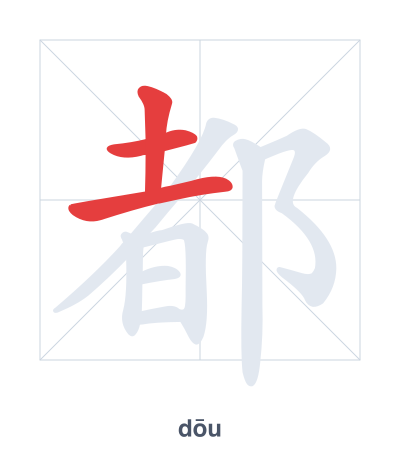
Open Hanzi Writer to see the animated stroke order and practice writing 都 with real-time feedback.
The character 都 (dōu/dū) is written with 10 strokes. Follow the standard Chinese stroke order: top to bottom, left to right, outside before inside. The radical 阝 is one of its key components.
Practice the correct stroke order with the Hanzi Writer app to see animated stroke-by-stroke guidance with real-time feedback.
都 means All / Both / Capital.
This is a polyphonic character with readings: dōu, dū.
As an HSK Level 1 character, 都 is among the first characters beginners learn.
都 combines 者 (a person or thing) on the left with 阝 (city) on the right. Its original meaning was 'capital city'—the place where the ruler and people gather. Over time, it also came to mean 'all' because everything is gathered together in one place.
💡 Memory Tip: Picture a capital city (阝) where every person (者) is present—that's 'all' of them, and it's the capital.
我们都是热爱和平的人。
wǒ men dōu shì rè ài hé píng de rén
We are all peace-loving people.
房间里的东西全都被收拾好了。
fáng jiān lǐ de dōng xī quán dōu bèi shōu shí hǎo le
Everything in the room has been tidied up.
北京是中国繁华的首都。
běi jīng shì zhōng guó fán huá de shǒu dū
Beijing is the bustling capital of China.
他很向往大都市的现代生活。
tā hěn xiàng wǎng dà dū shì de xiàn dài shēng huó
He yearns for the modern life of a big city.
Open Hanzi Writer to see the animated stroke order and practice writing 都 with real-time feedback.
✨ Animated stroke order · Handwriting recognition · HSK-graded practice · Free to use
The left component 阝 (ear radical) originally meant 'city' or 'wall', and the right component 者 provides sound. Together they form the meaning 'capital city' (dū), and the same character is also used for the adverb 'all' (dōu), which likely developed from the idea of 'everything in the capital'.