首 (shǒu) means "head or first" in Chinese. It has 9 strokes with the radical 首, and is HSK Level 3.
Rated 3.7/5 in difficulty (challenging).
Harder than 57% of HSK Level 3 characters.
Appears in 3+ common words including 首先 (shǒu xiān), 首都 (shǒu dū), 一首歌 (yī shǒu gē).
Due to its 9 strokes, Hanzi Writer's error detection shows 首 requires focused practice — most learners need 10+ attempts for consistent accuracy.
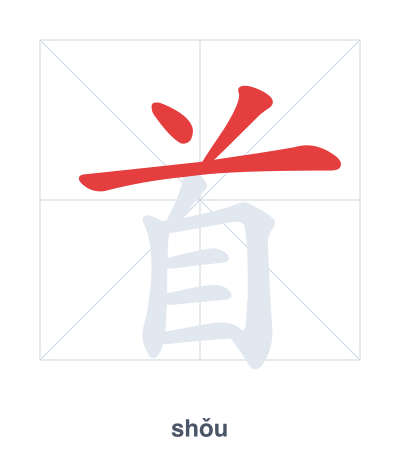
Open Hanzi Writer to see the animated stroke order and practice writing 首 with real-time feedback.
The character 首 (shǒu) is written with 9 strokes. Follow the standard Chinese stroke order: top to bottom, left to right, outside before inside. The radical 首 is one of its key components.
Practice the correct stroke order with the Hanzi Writer app to see animated stroke-by-stroke guidance with real-time feedback.
首 means head or first.
As an HSK Level 3 character, 首 is an intermediate-level character.
The character 首 originally depicted a head with hair and eyes, symbolizing the human head. Over time, it simplified to its current form, which still retains the idea of a head and has come to mean 'first' or 'beginning'.
💡 Memory Tip: Imagine a person with a big head (首) standing at the front of a line, indicating they are the first.
首先,我们要学习。
shǒu xiān wǒ men yào xué xí
First of all, we need to study.
北京是中国的首都。
běi jīng shì zhōng guó de shǒu dū
Beijing is the capital of China.
我听了一首歌。
wǒ tīng le yī shǒu gē
I listened to a song.
Open Hanzi Writer to see the animated stroke order and practice writing 首 with real-time feedback.
✨ Animated stroke order · Handwriting recognition · HSK-graded practice · Free to use
The character 首 is a pictograph that originally showed a head with hair and an eye. The top part represents the hair, and the bottom part is the face. This visual directly represents the head, and since the head is at the top of the body, it also came to mean 'first' or 'beginning'.