蹈 (dǎo) means "To step; to tread; to dance" in Chinese. It has 17 strokes with the radical 足, and is HSK Level 6.
Rated 4.2/5 in difficulty (advanced).
Harder than 94% of HSK Level 6 characters.
Appears in 3+ common words including 舞蹈 (wǔ dǎo), 手舞足蹈 (shǒu wǔ zú dǎo), 循规蹈矩 (xún guī dǎo jǔ).
Due to its 17 strokes, Hanzi Writer's error detection shows 蹈 requires focused practice — most learners need 10+ attempts for consistent accuracy.
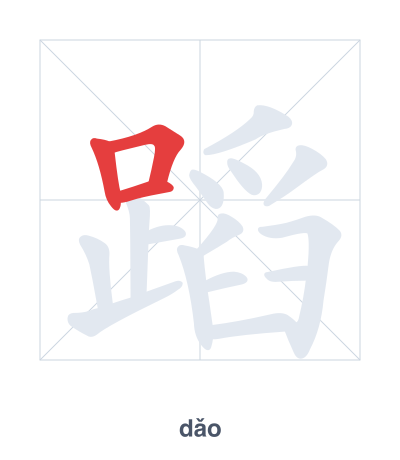
Open Hanzi Writer to see the animated stroke order and practice writing 蹈 with real-time feedback.
The character 蹈 (dǎo) is written with 17 strokes. Follow the standard Chinese stroke order: top to bottom, left to right, outside before inside. The radical 足 is one of its key components.
Practice the correct stroke order with the Hanzi Writer app to see animated stroke-by-stroke guidance with real-time feedback.
蹈 means To step; to tread; to dance.
As an HSK Level 6 character, 蹈 is an intermediate-level character.
蹈 is a phono-semantic compound: the radical 足 (foot) indicates the action involves the feet, while 舀 (yǎo) provides the pronunciation and originally pictured a hand dipping into a vessel, evoking the rhythmic, repeated motion of stepping or dancing.
💡 Memory Tip: Imagine your foot (足) scooping the ground like a ladle (舀) as you tread a dance step.
她从小就喜欢跳舞蹈。
tā cóng xiǎo jiù xǐ huān tiào wǔ dǎo
She has liked dancing since she was a child.
他高兴得手舞足蹈。
tā gāo xìng dé shǒu wǔ zú dǎo
He was so happy that he started dancing for joy.
他是一个循规蹈矩的人。
tā shì yí gè xún guī dǎo jǔ de rén
He is a person who follows the rules.
Open Hanzi Writer to see the animated stroke order and practice writing 蹈 with real-time feedback.
✨ Animated stroke order · Handwriting recognition · HSK-graded practice · Free to use
The character 蹈 combines the radical 足 (foot) on the left with 舀 (yǎo, meaning "to scoop") on the right. The foot radical shows that the meaning involves foot actions like stepping or dancing, while 舀 gives the pronunciation and hints at the rhythmic motion of scooping, similar to dance steps.