措 (cuò) means "to arrange; to handle; to manage" in Chinese. It has 11 strokes with the radical 扌, and is HSK Level 4.
Rated 4.2/5 in difficulty (advanced).
Harder than 70% of HSK Level 4 characters.
Appears in 3+ common words including 措施 (cuò shī), 措辞 (cuò cí), 惊慌失措 (jīng huāng shī cuò).
Due to its 11 strokes, Hanzi Writer's error detection shows 措 requires focused practice — most learners need 10+ attempts for consistent accuracy.
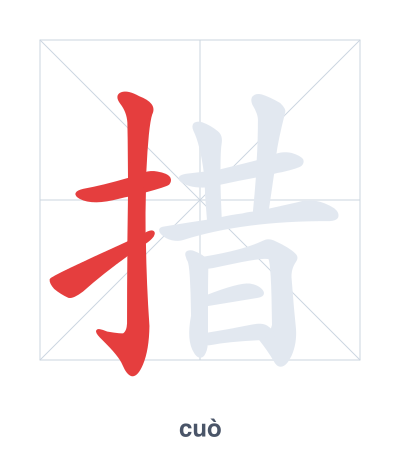
Open Hanzi Writer to see the animated stroke order and practice writing 措 with real-time feedback.
The character 措 (cuò) is written with 11 strokes. Follow the standard Chinese stroke order: top to bottom, left to right, outside before inside. The radical 扌 is one of its key components.
Practice the correct stroke order with the Hanzi Writer app to see animated stroke-by-stroke guidance with real-time feedback.
措 means to arrange; to handle; to manage.
As an HSK Level 4 character, 措 is an intermediate-level character.
The character 措 is a phono-semantic compound with the hand radical 扌 (action) and 昔 (phonetic, also meaning 'former'). It originally meant 'to place' or 'to put something in order,' later extending to 'arrange' and 'manage,' reflecting the hand's role in organizing items.
💡 Memory Tip: Picture a hand (扌) arranging old (昔) documents on a desk — that's how you manage and handle things.
我们要采取措施。
wǒ men yào cǎi qǔ cuò shī
We need to take measures.
他的措辞很委婉。
tā de cuò cí hěn wěi wǎn
His wording is very tactful.
别惊慌失措。
bié jīng huāng shī cuò
Don't panic.
Open Hanzi Writer to see the animated stroke order and practice writing 措 with real-time feedback.
✨ Animated stroke order · Handwriting recognition · HSK-graded practice · Free to use
The left side is the radical 扌 (hand), indicating actions done with the hand. The right side is 昔 (meaning "past" or "old"), which here suggests arranging things in order, like putting the past in its proper place. Together, they convey the idea of "to arrange or handle" something carefully.