进 (jìn) means "Enter / Come in" in Chinese. It has 7 strokes with the radical 辶, and is HSK Level 1.
Rated 2.9/5 in difficulty (moderate).
Harder than 59% of HSK Level 1 characters.
Appears in 3+ common words including 进来 (jìn lái), 进步 (jìn bù), 进入 (jìn rù).
Hanzi Writer's stroke validation shows learners typically need 5-8 attempts to write 进 with correct proportion and order.
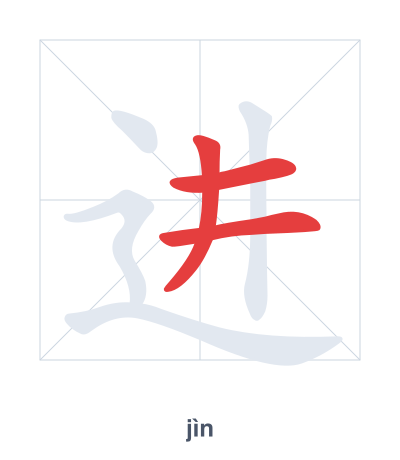
Open Hanzi Writer to see the animated stroke order and practice writing 进 with real-time feedback.
The character 进 (jìn) is written with 7 strokes. Follow the standard Chinese stroke order: top to bottom, left to right, outside before inside. The radical 辶 is one of its key components.
Practice the correct stroke order with the Hanzi Writer app to see animated stroke-by-stroke guidance with real-time feedback.
进 means Enter / Come in.
As an HSK Level 1 character, 进 is among the first characters beginners learn.
The simplified character 进 combines the radical 辶 (walk, movement) with 井 (well). This suggests moving forward or entering, like stepping into a well. The original traditional form 進 used a bird (隹) to convey the idea of advancing, but the simplified version keeps the core meaning of entering through movement.
💡 Memory Tip: Imagine a little stick figure (辶) running and leaping into a square well (井) to get inside a secret underground world.
请进来坐吧。
qǐng jìn lái zuò ba
Please come in and have a seat.
他的汉语进步很快。
tā de hàn yǔ jìn bù hěn kuài
His Chinese is improving very fast.
汽车进入了隧道。
qì chē jìn rù le suì dào
The car entered the tunnel.
Open Hanzi Writer to see the animated stroke order and practice writing 进 with real-time feedback.
✨ Animated stroke order · Handwriting recognition · HSK-graded practice · Free to use
The character 进 consists of the radical 辶 (walk/road) on the left, which indicates movement, and the character 井 (well) on the right, which provides a phonetic hint (pronounced jǐng). Together, the radical suggests the action of moving into a place, so 进 means "enter" or "come in."