闲 (xián) means "idle / free / leisure" in Chinese. It has 7 strokes with the radical 门, and is HSK Level 5.
Rated 3.5/5 in difficulty (challenging).
Harder than 29% of HSK Level 5 characters.
Appears in 3+ common words including 闲空 (xián kòng), 空闲 (kòng xián), 闲聊 (xián liáo).
Due to its 7 strokes, Hanzi Writer's error detection shows 闲 requires focused practice — most learners need 10+ attempts for consistent accuracy.
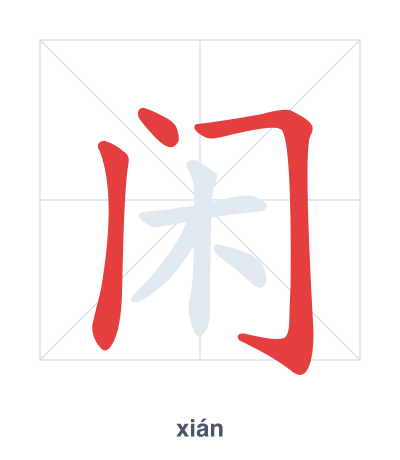
Open Hanzi Writer to see the animated stroke order and practice writing 闲 with real-time feedback.
The character 闲 (xián) is written with 7 strokes. Follow the standard Chinese stroke order: top to bottom, left to right, outside before inside. The radical 门 is one of its key components.
Practice the correct stroke order with the Hanzi Writer app to see animated stroke-by-stroke guidance with real-time feedback.
闲 means idle / free / leisure.
As an HSK Level 5 character, 闲 is an intermediate-level character.
闲 combines a gate (门) with wood (木), originally depicting a wooden bar across a gate to block entry. This barrier came to mean 'idle' or 'free'—like a gate closed with wood, keeping out activity and leaving time for leisure.
💡 Memory Tip: Picture a wooden beam (木) wedged inside a door (门) so you can't go out, leaving you free and idle at home.
你有闲空吗?
nǐ yǒu xián kōng ma
Are you free?
我现在很空闲。
wǒ xiàn zài hěn kòng xián
I am very free right now.
我们在闲聊。
wǒ men zài xián liáo
We are chatting.
Open Hanzi Writer to see the animated stroke order and practice writing 闲 with real-time feedback.
✨ Animated stroke order · Handwriting recognition · HSK-graded practice · Free to use
闲 is composed of the radical 门 (door/gate) and the component 木 (wood). Together, they suggest being behind a wooden door at home, implying a state of having free time or being idle.