往 (wǎng) means "to go; towards; past" in Chinese. It has 8 strokes with the radical 彳, and is HSK Level 2.
Rated 3.2/5 in difficulty (challenging).
Harder than 47% of HSK Level 2 characters.
Appears in 3+ common words including 往返 (wǎng fǎn), 往常 (wǎng cháng), 交往 (jiāo wǎng).
Due to its 8 strokes, Hanzi Writer's error detection shows 往 requires focused practice — most learners need 10+ attempts for consistent accuracy.
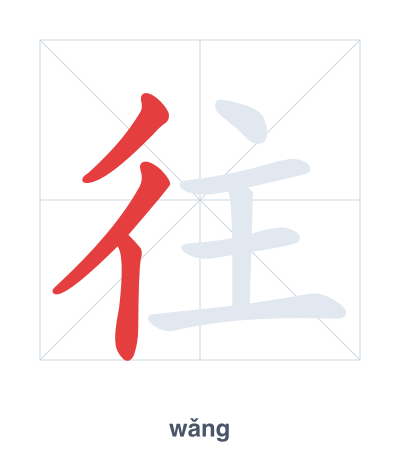
Open Hanzi Writer to see the animated stroke order and practice writing 往 with real-time feedback.
The character 往 (wǎng) is written with 8 strokes. Follow the standard Chinese stroke order: top to bottom, left to right, outside before inside. The radical 彳 is one of its key components.
Practice the correct stroke order with the Hanzi Writer app to see animated stroke-by-stroke guidance with real-time feedback.
往 means to go; towards; past.
As an HSK Level 2 character, 往 is among the first characters beginners learn.
The character combines the radical 彳 (step, action) with 㞢 (an ancient form of 之, meaning 'to go'), creating a compound that directly depicts the act of moving or proceeding. Over time, its meaning extended from physical movement to temporal direction ('past') and relational orientation ('towards').
💡 Memory Tip: Picture a traveler (彳) stepping forward behind a master (主) as they all go towards a distant goal.
往返票比单程票便宜。
wǎng fǎn piào bǐ dān chéng piào pián yi
Round-trip tickets are cheaper than one-way tickets.
他像往常一样去跑步。
tā xiàng wǎng cháng yī yàng qù pǎo bù
He went for a run as usual.
他们交往了很多年。
tā men jiāo wǎng le hěn duō nián
They have been dating for many years.
Open Hanzi Writer to see the animated stroke order and practice writing 往 with real-time feedback.
✨ Animated stroke order · Handwriting recognition · HSK-graded practice · Free to use
The left component 彳 means "step" or "walk" and shows that 往 relates to movement. The right component 主 (a dot on top of 王) originally provided a sound hint, but now you can think of the dot as a direction marker. Together, 彳 (movement) + 主 (direction) gives the meanings "to go" and "towards."