徂 (cú) means "to go; to pass (time)" in Chinese. It has 8 strokes with the radical 彳.
Rated 3.7/5 in difficulty (challenging).
Appears in 3+ common words including 徂暑 (cú shǔ), 徂徕 (cú lái), 徂迁 (cú qiān).
Due to its 8 strokes, Hanzi Writer's error detection shows 徂 requires focused practice — most learners need 10+ attempts for consistent accuracy.
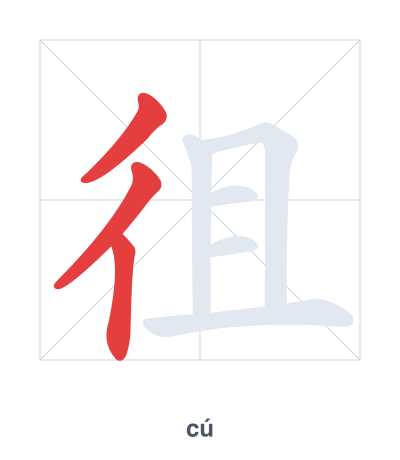
Open Hanzi Writer to see the animated stroke order and practice writing 徂 with real-time feedback.
The character 徂 (cú) is written with 8 strokes. Follow the standard Chinese stroke order: top to bottom, left to right, outside before inside. The radical 彳 is one of its key components.
Practice the correct stroke order with the Hanzi Writer app to see animated stroke-by-stroke guidance with real-time feedback.
徂 means to go; to pass (time).
The character 徂 combines the radical 彳 (step, indicating movement) with 且, which originally depicted an ancestral altar but here serves as a phonetic component suggesting the pronunciation cú. Together, the form signifies the action of going or the passage of time, as stepping forward implies both motion and temporal progress.
💡 Memory Tip: Imagine stepping (彳) on a calendar shelf (且) to make time go forward.
徂暑已过,秋天来了。
cú shǔ yǐ guò qiū tiān lái le
The summer heat has passed, and autumn has arrived.
徂徕山在山东省。
cú lái shān zài shān dōng shěng
Mount Culai is in Shandong Province.
时光徂迁,岁月不居。
shí guāng cú qiān suì yuè bù jū
Time passes and years do not stay.
Open Hanzi Writer to see the animated stroke order and practice writing 徂 with real-time feedback.
✨ Animated stroke order · Handwriting recognition · HSK-graded practice · Free to use
徂 is made of two parts: the left radical 彳 (chi), which means a small step or walking, and the right component 且 (qie), which provides the pronunciation. Together, they suggest the idea of moving forward or the passing of time, like stepping through moments.