真 (zhēn) means "real; true; really" in Chinese. It has 10 strokes with the radical 目, and is HSK Level 1.
Rated 3.4/5 in difficulty (challenging).
Harder than 74% of HSK Level 1 characters.
Appears in 3+ common words including 真的 (zhēn de), 真好 (zhēn hǎo), 认真 (rèn zhēn).
Due to its 10 strokes, Hanzi Writer's error detection shows 真 requires focused practice — most learners need 10+ attempts for consistent accuracy.
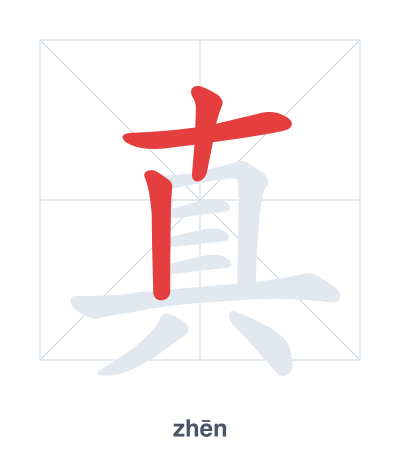
Open Hanzi Writer to see the animated stroke order and practice writing 真 with real-time feedback.
The character 真 (zhēn) is written with 10 strokes. Follow the standard Chinese stroke order: top to bottom, left to right, outside before inside. The radical 目 is one of its key components.
Practice the correct stroke order with the Hanzi Writer app to see animated stroke-by-stroke guidance with real-time feedback.
真 means real; true; really.
As an HSK Level 1 character, 真 is among the first characters beginners learn.
Originally, 真 depicted a person (匕) transforming inside a tripod (鼎), symbolizing the attainment of immortality—the ultimate reality. Over time, the form simplified to its current shape with 目 (eye) as the radical, emphasizing 'seeing the truth clearly.'
💡 Memory Tip: Imagine a true detective (十) using one huge eye (目) to see through eight (八) layers of lies.
这是真的吗?
zhè shì zhēn de ma
Is this true?
今天天气真好。
jīn tiān tiān qì zhēn hǎo
The weather is really nice today.
他学习很认真。
tā xué xí hěn rèn zhēn
He studies very seriously.
Open Hanzi Writer to see the animated stroke order and practice writing 真 with real-time feedback.
✨ Animated stroke order · Handwriting recognition · HSK-graded practice · Free to use
真 contains the radical 目 (eye) at the top and 八 (eight) at the bottom. In ancient writing, the shape suggested a person standing upright, conveying the idea of being genuine and not false. The eye component emphasizes seeing or revealing what is real.