著 (zhù) means "to write / famous" in Chinese. It has 11 strokes with the radical 艹, and is HSK Level 4.
Rated 4.2/5 in difficulty (advanced).
Harder than 90% of HSK Level 4 characters.
Appears in 3+ common words including 著名 (zhù míng), 著作 (zhù zuò), 显著 (xiǎn zhù).
Due to its 11 strokes, Hanzi Writer's error detection shows 著 requires focused practice — most learners need 10+ attempts for consistent accuracy.
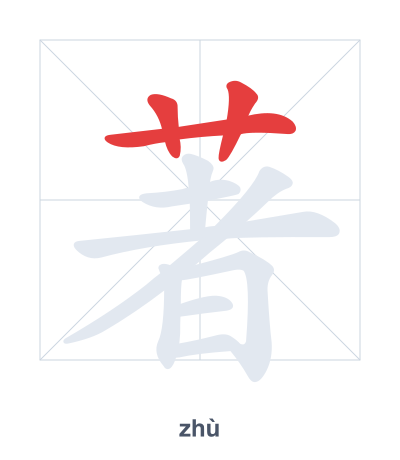
Open Hanzi Writer to see the animated stroke order and practice writing 著 with real-time feedback.
The character 著 (zhù) is written with 11 strokes. Follow the standard Chinese stroke order: top to bottom, left to right, outside before inside. The radical 艹 is one of its key components.
Practice the correct stroke order with the Hanzi Writer app to see animated stroke-by-stroke guidance with real-time feedback.
著 means to write / famous.
As an HSK Level 4 character, 著 is an intermediate-level character.
著 combines the radical 艹 (grass) with 者 (person), where 者 provides sound. Originally meaning 'to manifest' like plants emerging from soil, the character evolved to mean 'to write' because writing makes ideas visible, and thus 'famous' for being widely seen.
💡 Memory Tip: Picture a famous author sitting under a grass roof (艹) writing a book while a reader (者) applauds.
他是一位著名的作家。
tā shì yī wèi zhù míng de zuò jiā
He is a famous writer.
这是一本伟大的著作。
zhè shì yī běn wěi dà de zhù zuò
This is a great work.
他的进步很显著。
tā de jìn bù hěn xiǎn zhù
His progress is significant.
Open Hanzi Writer to see the animated stroke order and practice writing 著 with real-time feedback.
✨ Animated stroke order · Handwriting recognition · HSK-graded practice · Free to use
The character 著 consists of the radical 艹 (grass) on top and 者 (person) below. The grass radical suggests something that grows or is visible, while 者 indicates a person or agent, together implying something that is recorded or made famous, like a notable work or person.