名 (míng) means "Name, fame, or measure word for people" in Chinese. It has 6 strokes with the radical 口, and is HSK Level 1.
Rated 2.7/5 in difficulty (moderate).
Harder than 40% of HSK Level 1 characters.
Appears in 3+ common words including 名字 (míng zì), 有名 (yǒu míng), 报名 (bào míng).
Hanzi Writer's stroke validation shows learners typically need 5-8 attempts to write 名 with correct proportion and order.
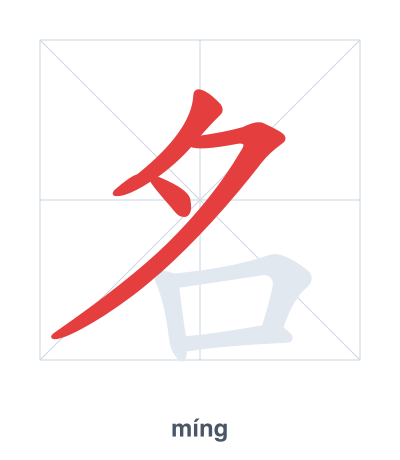
Open Hanzi Writer to see the animated stroke order and practice writing 名 with real-time feedback.
The character 名 (míng) is written with 6 strokes. Follow the standard Chinese stroke order: top to bottom, left to right, outside before inside. The radical 口 is one of its key components.
Practice the correct stroke order with the Hanzi Writer app to see animated stroke-by-stroke guidance with real-time feedback.
名 means Name, fame, or measure word for people.
As an HSK Level 1 character, 名 is among the first characters beginners learn.
名 is a compound of 口 (mouth) and 夕 (moon/evening). In ancient times, when it was dark and you couldn't see someone's face, you would call out their name using your mouth. Thus, the character visually represents 'speaking a name in the dark.'
💡 Memory Tip: At dusk (夕), you need to use your mouth (口) to announce your name because nobody can see you.
你叫什么名字?
nǐ jiào shén me míng zì
What is your name?
这家饭馆很有名。
zhè jiā fàn guǎn hěn yǒu míng
This restaurant is very famous.
我想报名学中文。
wǒ xiǎng bào míng xué zhōng wén
I want to sign up to learn Chinese.
Open Hanzi Writer to see the animated stroke order and practice writing 名 with real-time feedback.
✨ Animated stroke order · Handwriting recognition · HSK-graded practice · Free to use
名 is made of two parts: 夕 (evening) on top and 口 (mouth) below. Originally, it meant calling someone's name in the dark, so the mouth speaks a name at evening. Today it means 'name' or 'fame'.