苧 (níng) means "Ramie / limonene" in Chinese. It has 9 strokes with the radical 艹.
Rated 4/5 in difficulty (challenging).
Appears in 3+ common words including 苧麻 (níng má), 苧烯 (níng xī), 苧萝 (níng luó).
Due to its 9 strokes, Hanzi Writer's error detection shows 苧 requires focused practice — most learners need 10+ attempts for consistent accuracy.
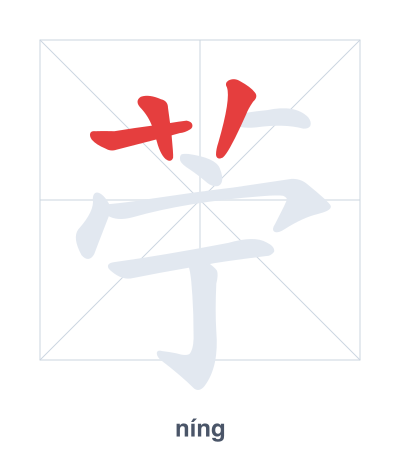
Open Hanzi Writer to see the animated stroke order and practice writing 苧 with real-time feedback.
The character 苧 (níng) is written with 9 strokes. Follow the standard Chinese stroke order: top to bottom, left to right, outside before inside. The radical 艹 is one of its key components.
Practice the correct stroke order with the Hanzi Writer app to see animated stroke-by-stroke guidance with real-time feedback.
苧 means Ramie / limonene.
苧 is a compound character with the grass radical 艹 indicating it is a plant, and 宁 (níng) providing the phonetic hint. It originally referred to ramie, a plant used for fiber, and later also for limonene, a chemical compound.
💡 Memory Tip: Picture a green grass roof (艹) over a peaceful house (宁) where ramie fibers are stored and smell of lemony limonene.
苧麻可以用来织布。
níng má kě yǐ yòng lái zhī bù
Ramie can be used to weave cloth.
橙皮里含有苧烯。
chéng pí lǐ hán yǒu níng xī
Orange peel contains limonene.
这是苧萝村的故事。
zhè shì níng luó cūn de gù shì
This is the story of Zhuluo Village.
Open Hanzi Writer to see the animated stroke order and practice writing 苧 with real-time feedback.
✨ Animated stroke order · Handwriting recognition · HSK-graded practice · Free to use
苧 is composed of the radical 艹 (grass radical) on top and the phonetic component 宁 (níng) below. The grass radical indicates the character relates to plants, which connects to its meaning of ramie, a plant used for fiber. The bottom part 宁 provides the pronunciation but does not contribute to the meaning.