跃 (yuè) means "to jump; to leap" in Chinese. It has 11 strokes with the radical 足, and is HSK Level 6.
Rated 4.2/5 in difficulty (advanced).
Harder than 91% of HSK Level 6 characters.
Appears in 3+ common words including 跳跃 (tiào yuè), 飞跃 (fēi yuè), 活跃 (huó yuè).
Due to its 11 strokes, Hanzi Writer's error detection shows 跃 requires focused practice — most learners need 10+ attempts for consistent accuracy.
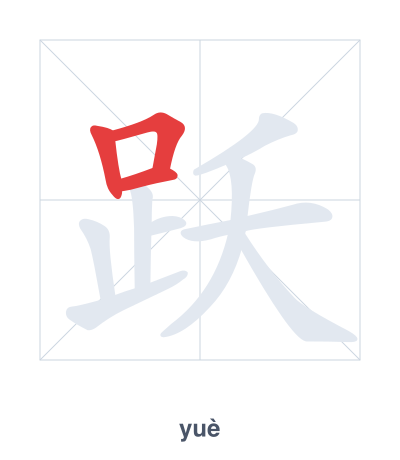
Open Hanzi Writer to see the animated stroke order and practice writing 跃 with real-time feedback.
The character 跃 (yuè) is written with 11 strokes. Follow the standard Chinese stroke order: top to bottom, left to right, outside before inside. The radical 足 is one of its key components.
Practice the correct stroke order with the Hanzi Writer app to see animated stroke-by-stroke guidance with real-time feedback.
跃 means to jump; to leap.
As an HSK Level 6 character, 跃 is an intermediate-level character.
The character 跃 combines the radical 足 (foot) with the component 夭, which originally depicted a person bending or swaying. Together, they suggest the motion of a foot pushing off the ground in a leaping or jumping action. The right side 夭 also provides a phonetic hint for the pronunciation yuè.
💡 Memory Tip: Imagine a foot (足) kicking off the ground with such force that the person's body bends like a dancer (夭) as they leap into the air.
鱼在水里跳跃。
yú zài shuǐ lǐ tiào yuè
The fish is jumping in the water.
科技有了新的飞跃。
kē jì yǒu le xīn de fēi yuè
Science and technology have made a new leap.
课堂气氛非常活跃。
kè táng qì fēn fēi cháng huó yuè
The classroom atmosphere is very lively.
Open Hanzi Writer to see the animated stroke order and practice writing 跃 with real-time feedback.
✨ Animated stroke order · Handwriting recognition · HSK-graded practice · Free to use
The left side is the radical 足, meaning "foot" or "leg." The right side is 夭, which originally depicted a person bending or swaying. Together, they suggest a foot action of leaping or springing upward.