活 (huó) means "live / alive / work" in Chinese. It has 9 strokes with the radical 氵, and is HSK Level 2.
Rated 3.5/5 in difficulty (challenging).
Harder than 64% of HSK Level 2 characters.
Appears in 3+ common words including 生活 (shēng huó), 活动 (huó dòng), 干活 (gàn huó).
Due to its 9 strokes, Hanzi Writer's error detection shows 活 requires focused practice — most learners need 10+ attempts for consistent accuracy.
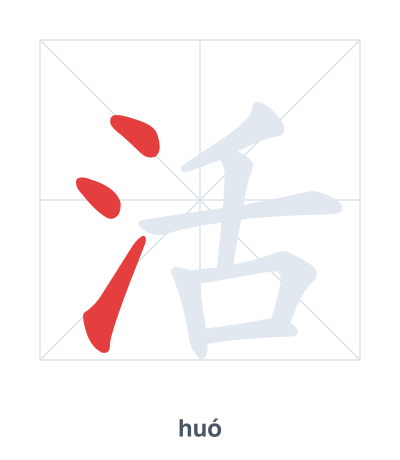
Open Hanzi Writer to see the animated stroke order and practice writing 活 with real-time feedback.
The character 活 (huó) is written with 9 strokes. Follow the standard Chinese stroke order: top to bottom, left to right, outside before inside. The radical 氵 is one of its key components.
Practice the correct stroke order with the Hanzi Writer app to see animated stroke-by-stroke guidance with real-time feedback.
活 means live / alive / work.
As an HSK Level 2 character, 活 is among the first characters beginners learn.
活 combines the water radical 氵 with 舌 (tongue). Originally it depicted flowing water, suggesting movement and life—since water that moves is fresh and lively, unlike stagnant water. Over time, it expanded to mean 'live' or 'alive', with the tongue hinting at the breath and speech of a living being.
💡 Memory Tip: Picture a thirsty tongue (舌) lapping up water (氵) to stay alive.
他的生活很开心。
tā de shēng huó hěn kāi xīn
His life is very happy.
明天有学校活动。
míng tiān yǒu xué xiào huó dòng
There are school activities tomorrow.
爸爸在外面干活。
bà bà zài wài miàn gàn huó
Dad is working outside.
Open Hanzi Writer to see the animated stroke order and practice writing 活 with real-time feedback.
✨ Animated stroke order · Handwriting recognition · HSK-graded practice · Free to use
活 is made of the water radical 氵 on the left and 舌 (tongue) on the right. Water is essential for life, and the tongue represents a living being’s ability to taste or speak, connecting to the meanings "live" and "alive."