喻 (yù) means "metaphor, to explain" in Chinese. It has 12 strokes with the radical 口, and is HSK Level 7.
Rated 4.2/5 in difficulty (advanced).
Harder than 49% of HSK Level 7 characters.
Appears in 3+ common words including 比喻 (bǐ yù), 喻为 (yù wèi), 家喻户晓 (jiā yù hù xiǎo).
Due to its 12 strokes, Hanzi Writer's error detection shows 喻 requires focused practice — most learners need 10+ attempts for consistent accuracy.
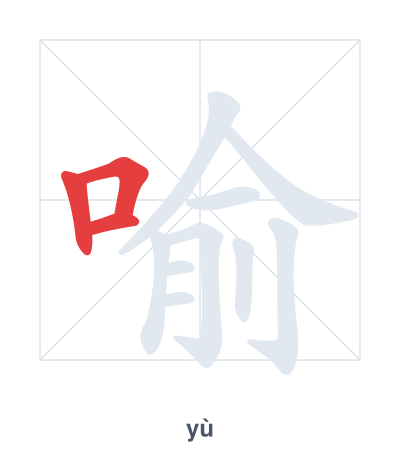
Open Hanzi Writer to see the animated stroke order and practice writing 喻 with real-time feedback.
The character 喻 (yù) is written with 12 strokes. Follow the standard Chinese stroke order: top to bottom, left to right, outside before inside. The radical 口 is one of its key components.
Practice the correct stroke order with the Hanzi Writer app to see animated stroke-by-stroke guidance with real-time feedback.
喻 means metaphor, to explain.
As an HSK Level 7 character, 喻 is an intermediate-level character.
喻 combines the mouth radical (口) for speech with the phonetic component 俞 (yú). Together, they suggest using words to draw comparisons, hence the meanings 'metaphor' or 'to explain.'
💡 Memory Tip: Picture a mouth (口) saying 'You' (俞 sounds like 'you') to explain a metaphor without directly stating it.
这个比喻非常生动。
zhè ge bǐ yù fēi cháng shēng dòng
This metaphor is very vivid.
他被喻为天才少年。
tā bèi yù wèi tiān cái shào nián
He was hailed as a child prodigy.
这个故事家喻户晓。
zhè ge gù shì jiā yù hù xiǎo
This story is known to everyone.
Open Hanzi Writer to see the animated stroke order and practice writing 喻 with real-time feedback.
✨ Animated stroke order · Handwriting recognition · HSK-graded practice · Free to use
The character 喻 has the radical 口 (mouth) on the left and the phonetic component 俞 (yú) on the right. The mouth radical suggests speaking or explaining, while 俞 provides the sound and can imply 'approve' or 'transport,' together creating the idea of using words to convey a comparison or explanation.