哥 (gē) means "Older brother" in Chinese. It has 10 strokes with the radical 口, and is HSK Level 1.
Rated 3.4/5 in difficulty (challenging).
Harder than 73% of HSK Level 1 characters.
Appears in 3+ common words including 哥哥 (gē gē), 大哥 (dà gē), 帅哥 (shuài gē).
Due to its 10 strokes, Hanzi Writer's error detection shows 哥 requires focused practice — most learners need 10+ attempts for consistent accuracy.
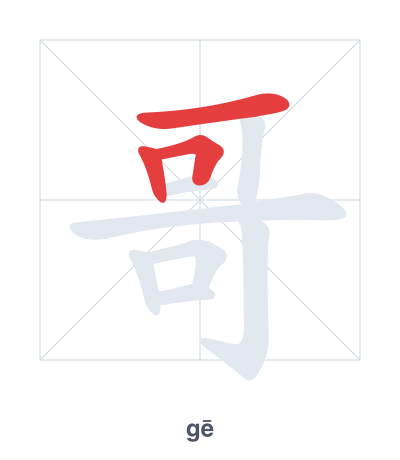
Open Hanzi Writer to see the animated stroke order and practice writing 哥 with real-time feedback.
The character 哥 (gē) is written with 10 strokes. Follow the standard Chinese stroke order: top to bottom, left to right, outside before inside. The radical 口 is one of its key components.
Practice the correct stroke order with the Hanzi Writer app to see animated stroke-by-stroke guidance with real-time feedback.
哥 means Older brother.
As an HSK Level 1 character, 哥 is among the first characters beginners learn.
哥 is a compound of two 可 (kě) stacked vertically, each containing a 口 (mouth). The doubling originally meant 'to sing' (harmonizing voices) but was later borrowed phonetically to mean 'older brother', evoking the idea of two voices or siblings together.
💡 Memory Tip: Picture two mouths (口) stacked on top of each other—the top mouth is your older brother always speaking down to you.
我哥哥是学生。
wǒ gē gē shì xué shēng
My older brother is a student.
他是我的大哥。
tā shì wǒ de dà gē
He is my eldest brother.
那个帅哥是谁?
nà ge shuài gē shì shuí
Who is that handsome guy?
Open Hanzi Writer to see the animated stroke order and practice writing 哥 with real-time feedback.
✨ Animated stroke order · Handwriting recognition · HSK-graded practice · Free to use
The character 哥 is made of two identical parts stacked vertically, each being 可 (kě) which contains the mouth radical 口. This repetition symbolizes two brothers, with the top part representing the older brother and the bottom the younger.