比 (bǐ) means "To compare / Than" in Chinese. It has 4 strokes with the radical 比, and is HSK Level 1.
Rated 1.9/5 in difficulty (beginner-friendly).
Harder than 16% of HSK Level 1 characters.
Appears in 3+ common words including 比较 (bǐ jiào), 比赛 (bǐ sài), 比如 (bǐ rú).
In the Hanzi Writer app, most learners master 比 within 3 practice attempts using stroke-by-stroke animation.
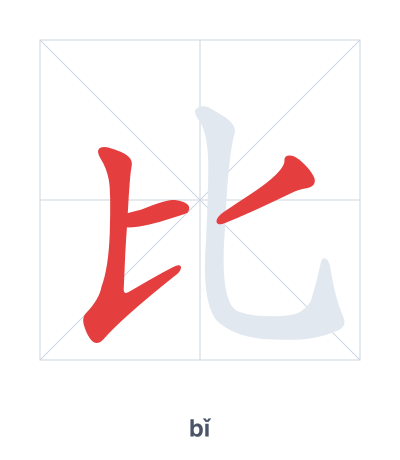
Open Hanzi Writer to see the animated stroke order and practice writing 比 with real-time feedback.
The character 比 (bǐ) is written with 4 strokes. Follow the standard Chinese stroke order: top to bottom, left to right, outside before inside. The radical 比 is one of its key components.
Practice the correct stroke order with the Hanzi Writer app to see animated stroke-by-stroke guidance with real-time feedback.
比 means To compare / Than.
As an HSK Level 1 character, 比 is among the first characters beginners learn.
比 is a pictograph of two persons standing side by side, originally depicting closeness or pairing. Its visual form of two identical figures (匕 匕) represents the act of comparing two things placed together.
💡 Memory Tip: Picture two identical spoons (匕) placed side by side on a table—you compare them to see which is bigger.
今天比较冷。
jīn tiān bǐ jiào lěng
It's quite cold today.
足球比赛开始了。
zú qiú bǐ sài kāi shǐ le
The soccer match has started.
我喜欢水果,比如苹果。
wǒ xǐ huān shuǐ guǒ bǐ rú píng guǒ
I like fruit, such as apples.
Open Hanzi Writer to see the animated stroke order and practice writing 比 with real-time feedback.
✨ Animated stroke order · Handwriting recognition · HSK-graded practice · Free to use
The character 比 is made of two identical components called 匕 (bǐ), which originally meant 'spoon' or 'dagger'. Placed side by side, they represent two items being compared or placed next to each other.